Showing posts with label alan clarke. Show all posts

Thursday, 15 June 2017

'Spokesperson for the Doomed': a Backlisted podcast on the oral history of Warren Zevon


My Zevon collection, or a cross-section...

A few notes as background to my contribution to this podcast about Crystal Zevon's 'oral history' biography of her ex-husband the songwriter Warren Zevon,entitled I'll Sleep When I'm Dead, which she compiled at his express request following his death from cancer in 2003. The host is the superb Backlisted site run by Andy Miller and John Mitchinson, an invaluable resource for all lovers of good books young and old (and by that I mean both listeners and books...)

1. Zevon was, in Bruce Springsteen’s view and mine, 'one of the great American songwriters.'  Listen to anything of his and you will quickly pick up on the bite, erudition and humour of someone who understood the secret badness of the world and could still make it sound uncommonly elegant.

2. If you’ve never listened to Zevon previously you can start with this top ten that I compiled as a Spotify playlist. Full disclosure: the inclusion of Werewolves of London is rather a sop to it being his Greatest Hit – if headed to a desert island I would prefer Renegade from the Mr Bad Example album. I’d take Werewolves, though, were it Zevon’s live version circa 1980 in which he would re-jig the lyrics to name-check Mailer’s Executioner’s Song and Brian De Palma’s movie Dressed to Kill, wearing his cultural smarts proudly in the manner for which we loved him.

3. The reason I heard that live tape, and umpteen other such rarities, was thanks to a woman called Diane Berger who ran one of the internet’s early WZ fanpages under the moniker of zevonfan1, and who sent me all sorts of dubbed copies in the mail from the US circa 1996 – great generosity born of shared enthusiasm.

4. If I’m a little less of a Zevon fan today than I was then, it’s because I have never quite gotten over reading Crystal Zevon's book. Anyone who teaches Creative Writing and has recourse to the canon of great American short stories will know that sinking feeling when for the umpteenth time while stood before a group of undergraduates you are forced to observe, ‘Of course his life and work were greatly affected by his addiction to alcohol...’ Thus Fitzgerald, Cheever, Carver et al. And thus Zevon.

5. I had known Zevon was a very bad drunk during his lowest personal ebb, and yet his extraordinary gift for a rueful love song and the melancholy beauty of his turn of phrase tended me to see him as a man who had been more often ill-used than using, more hurt than hurting. Well, Crystal's book sure turned my head round on that score, notably from the point where she first describes Warren punching her in the face... She forgave him, at length and over time, and of course the credit and debit sides must be carefully balanced by those who weren't there. But still, talk about a nail in the coffin of the myth of the romantic troubadour. Goodbye to All That, as they say.

6. I’ve written two oral histories myself: Alan Clarke and Sean Penn: His Life and Times. The form demands a subject who’s lively, who inspires the telling of tales, even – or especially – contradictory ones. It can be useful if that subject was a bit of a hellraiser - though raising hell can get wearying to read about, just as it can be to observe, and even to participate in. Crystal Zevon’s book arguably has a shade too much of Zevon’s worst behaviour. Regarding the work, while it’s great on the 1970s period which its author knows intimately, and on where Zevon’s songs came from at that time, it’s a little less satisfying about the body of work from 1987-2002, which I think includes most of his best stuff.

7. A confession: I’ve never really listened much to The Wind, the album that Zevon made at great speed with assorted collaborators in the period between his cancer diagnosis and his death. As artists sometimes do, he tried to direct the way he went out, to set-design his final curtain; but his work had always been coloured by the black wisdom that everybody’s headed for a hole in the ground.To wit, this observation from a 2003 interview in the New York Times:


8. Favourite Zevon lyrics? Too many to mention. But the following staves just seem to me an unusually brilliant run to have inserted in a pop song: namely Porcelain Monkey, which is about the life of Elvis Presley, a subject Zevon characteristically dismissed as ‘a very sad story, and not an interesting sad story.’ Zevon, in fact, made plain that in 1977 he was more upset by Robert Lowell’s passing than by Presley’s. But to which of those two gentlemen can Zevon’s accomplishment be more usefully compared?

From a shotgun shack singing Pentecostal hymns,
Through the wrought iron gates, to the TV room,
He had a little world, it was smaller than your hand,
It's a rockabilly ride from the glitter to the gloom.
Left behind by the latest trends,
Eating fried chicken with his regicidal friends,
That's how the story ends,
With a porcelain monkey...

Monday, 18 April 2016

To Belfast, for 'Alan Clarke in Northern Ireland'


This weekend just past gifted me a chance to revisit the work of Alan Clarke and my book about his life and times. The past beckoned me in for more than one reason, too.

I was at the Belfast Film Festival, which was presenting a sidebar of Clarke’s films on Northern Irish themes, and I gave a talk before the screening of Elephant (1988), the 38-minute tour de force that Clarke co-conceived with then-producer Danny Boyle and Steadicam maestro John Ward. The venue was the Queen’s Film Theatre, splendidly refurbished since its amiably distressed lecture-hall ambience in the 1980s when as a teenager I sat and watched Battleship Potemkin and Rashomon and Blue Velvet.

The Festival grew out of West Belfast, and its Feile an Phobail founded in 1988 subsequent to a particularly dreadful passage in the ‘Long War.’ It’s gradually expanded itself into a city-wide offering. The environment is good and buzzy, the programming by Stephen Hackett is superb, and the festival has an admirable commitment to community outreach, also to archival work and introducing the tools of film and their worth to a wider public. On the liaison side I was very well met by and enjoyed the company of Jim Meredith and Sean Osborne. And one great perk of the event was that I got to chat to Jennifer McAufield and Paul Clarke, who actually worked with Clarke on Elephant (as First AD and Designer respectively.)

My lodging in Belfast was the famous Europa Hotel, also vastly improved (for starters we drove right up to the door and I walked straight in) since Clarke and Ward stayed there in 1988 during the production of Elephant: I recall John Ward describing to me the inevitable bomb scare he and Clarkey endured back then, the precautionary piling of mattresses against windows by staff, the plying of guests with free booze as if to stiffen resolve.

Belfast's Europa Hotel, April 2016
If you stroll the centre of Belfast now the surface effect of years of peace dividend are clear; also the fruits of how much European money underwrote post-conflict reconstruction. That said, the visible campaigning for the Stormont elections in May would remind you that politics there retains a whole horde of familiar hostilities. And you don’t seriously assess the health of a city by its main commercial thoroughfares, agreeable as they are these days.

But, be there no mistake, it’s only one of a million things that speak well of the political processes of the last twenty years – and the resultant opening-out of the society – to say that all sorts of films can now be made in Northern Ireland. I only wonder what kind of film Alan Clarke might have made in Belfast today, had he lived?

Moreover – you see I did some thinking – how was it that back in the 1980s Alan Clarke became such a voice on the subject? Fair enough, quite a few of his contemporaries (Loach and Leigh inter alia) came to Belfast and made films: it was obvious, pertinent, arresting subject matter. But Clarke’s Northern Ireland films aren’t like anyone else’s. They’re pretty exceptional in the history of film, full stop.

Here’s the thing, in my view. The 1980s are when Clarke began to evolve from the loyal, driven collaborator of writers like Roy Minton and David Leland to being an auteur of the TV play: a director who put his signature on the work through formal choices with the camera and in the cut that were so bold that the script began to seem only a point of departure. And Northern Ireland by the 1980s was increasingly a terrain for storytelling where traditional three-act narrative looked inadequate to the thorny reality – the issue of what side you came down on leaving the filmmaker liable to run into dramatic dead ends just as implacable as ‘peace walls’.

Clarke, moreover, saw things with a different eye; and it was useful that he didn’t hew to an ideological line. I remember asking Roy Minton what were Clarke’s ‘politics’. Roy replied, ‘He didn’t have any... I was Left, and it got as bad as joining The Communist Party. But what Alan had was the indignation, he recognised injustice.’   

Psy-Warriors (1981)
Of the three Clarke films showing in Belfast, David Leland’s Psy-Warriors (1981) has aged least well, I’d say. Its premise is that three suspected terrorists are being interrogated in special cells following a pub bombing near Aldershot army barracks that bears the hallmark of the IRA. The viewer isn’t spoon-fed this information: the film is aggressively disorienting in its use of sound and space and cutting, Clarke wants you to feel a bit of the deranging nature of interrogation. Leland had been inspired by Peter Watson's book War on the Mind: The Military Uses and Abuses of Psychology

Gradually you sense Psy-Warriors really wants to advance an idea of a symbiotic relationship between governments and terror threats, as oft inferred from Reginald Maudling’s infamous line about an ‘acceptable level of violence’ in Northern Ireland, and the attendant theory that the six counties were a kind of policy laboratory for the security forces of the British state. Colin Blakely, the late great character actor from County Down, is very good as the chief interrogator. Yet when he speaks in high solemnity about the rationales of the Baader-Meinhof gang, you can feel the film’s intended critique of the repressive state succumbing to the fallacy of taking all self-declared revolutionaries on their own terms. If violence is really to be read as a kind of communication, you’re best to read what it’s really saying with some care.

Sean Chapman as the commander in Contact (1984)
Contact (1984) is my favourite among Clarke films, but it travels some way from its source material, which is A.F.N. (‘Tony’) Clarke’s memoir of commanding a paratroop patrol on border duty in Crossmaglen in 1976. Tony Clarke certainly wrote a script, and the film extracts a concentrated essence of something that strikes you on the page of his book: the loneliness of command when leading men on hazardous operations against a largely invisible enemy in ‘bandit country’. But Alan Clarke’s film replaces Tony Clarke’s frank, unleashed, first-person voice with the sense of the camera at a remove from the fray, an austere God’s-eye observer, as close to birdsong and trees and to carpets of green field as to the soldiers moving warily across them – at least until ‘contact’ occurs, at any rate.

Clarke had his cast drilled within an inch of military discipline, and during the shoot he steadily pared away the script’s exposition and dialogue. He put long lenses on a moving camera and the actors began to lose that sense of the line between being ‘on’ and ‘off’, such that they just behaved as soldiers like they’d learned how to. For the viewer it becomes redundant to ask whether Contact is sympathetic or otherwise to the presence of the British Army in South Armagh. To appreciate the film properly you just have to try to walk a mile in a squaddie’s boots. Contact is as pertinent a study of soldiering now, in the age of the Three-Block War, as it was in 1984. But it’s just masterful filmmaking by any measure. According to John Ward, who did time on Full Metal Jacket and Eyes Wide Shut, Stanley Kubrick was a big admirer of Contact. And Kubrick knew about war films.

From Elephant (1988)
Elephant (1988) is unique and unclassifiable. Ironically, Danny Boyle arrived in Northern Ireland as a BBC producer with the express aim of encouraging writers and dramas that weren’t inexorably bound to accounts of paramilitary killings. He shepherded scripts by Paul Muldoon, John McGahern, Anne Devlin, Frank McGuinness – and those films were all very different and distinctive. But Boyle really wanted to work with Alan Clarke, whom he revered, and it just so happened that what they did together emerged as the ‘Troubles’ statement to end them all.

Clarke and Boyle resolved to present a series of fatal shootings, with no context or dialogue or identifying marks. Clarke and John Ward figured out how and where to film these, like a sequence of short films, two a day. Once in the can they were laid end to end, ‘a remorseless way of presentation’, as Boyle described it to me. Clarke would re-jig the original running order, and he left out a couple of pieces he’d shot. But you can’t really imagine any other final cut of this film.

Some of the killings happen swiftly and starkly, on a doorstep, in a car-park or a petrol station forecourt. More breath-catching ones that build up anticipation and dread occur in a swimming pool and a municipal park. There’s no slack: each assassin shoots straight then makes their escape. But it does get steadily more upsetting. You start to watch each new scenario and think, who is the gunman here, who the victim? Or from which edge of the frame will the threat appear? And can nobody escape their seeming fate? That feeling is especially acute in the sequence where two gunmen, one with a shotgun, stalk a victim who makes a hopeless effort to crawl to safety after sustaining a leg wound. The final sequence – an enigma – depicts a man being escorted through a deserted factory to the site of his own execution.


It’s an obvious thing to observe that Elephant is a film about a ‘cycle of violence’, with that degree of pained futility about it. One or two commentators, I think, have linked it to a later endeavour, the great literary obituary of the Long War, Lost Lives (1999, ed. McKittrick et al); but then that book makes very clear that murder was something inflicted on over three thousand named individuals in very specific places, and that those people had life-stories of their own. The subject of Elephant, though, is just the process of cold-blooded killing; and your mission as a viewer, should you choose to accept it, is to ponder that subject – in the dark while the thing unspools, and in your head afterward once the lights have gone up.

For me it was certainly a thing to watch it and think about it one more time in Belfast, 28 years - but only a short walk away - from where it was made.

Tuesday, 8 March 2016

The BFI's 'Complete Alan Clarke'

The late Alan Clarke is one of those artists whose reputation is like a rumour, or a challenge. The body of work is attended by controversy, and those in the know tend to say that no-one did it better or tougher than when Clarkey did it – the ‘it’ in question being plays for television, the ‘when’ being the dramatically rich era of the 1970s and 1980s.

I’m always keen to have a hand in spreading the good word about Clarke. In 1998 I wrote his biography for Faber and Faber, my first published book. I say ‘wrote’ but it was really a work of oral history, George Plimpton-style, where I interviewed a wealth of his friends and family, collaborators and lovers, and stitched those transcripts into one multi-vocal life story. And I daresay Clarke’s life tells you as much about Britain, class and society in those years as his films do. My favourite review of the book, you’ll not be surprised, is this one by David Thomson, he of the Biographical Dictionary of Cinema, who was a big early champion of Clarke among the film-critical fraternity.

Now, Clarkey fans are living in exciting times, because at the end of March the BFI will start rolling out a huge tribute, ‘The Complete Alan Clarke’, with events and screenings at the South Bank and a comprehensive DVD/Blu-Ray boxset. There have been other such celebrations since Clarke’s death in 1990 – I helped Lizzie Francke and the Edinburgh Film Festival with one such in 1998 – but the BFI platform gets a huge boon from having the Clarke oeuvre packaged up so marvellously in one collectable digital set. 

Sam Dunn at the BFI has been the overseer of this great undertaking, and I’ve been happy to chip in a few embellishments to the boxset: new essays on Road and The Firm for the booklets, and an audio commentary with national-treasure actress Janine Duvitski for Diane, one of Janine's earliest screen roles, possibly her best. My book is going on sale again, and I think I’ll be giving a public talk or two once the season goes out and about countrywide.

Looking again at just a few of Clarke’s films I was pleased but unsurprised that age doesn’t wither them, because they were made with such care and conviction, such focus and force. Clarke was only interested in strong-meat subject matter, and he cut to the bone and cast aside the fat. I would love to see what new audiences will think and feel as they come for the first time to Penda’s Fen or Made in Britain, Scum or Elephant, Contact or Christine, et cetera.

Working on the book was a very happy time for me, one I owe to Walter Donohue, editor of the Faber film list who had input in that moment from the brilliant soon-to-be award-winning filmmaker Kevin Macdonald. It was late November 1997 when Kevin gave me the green light to start writing Alan Clarke – on the proviso that I deliver in March 1998 so that finished books could be ready for Edinburgh that summer. I made it, just, having met about 70 remarkable people over 16 weeks, some of them now gone, alas – such as producer Mark Shivas, cameraman John Ward, and the great Brecht scholar John Willett, who helped out Clarke and David Bowie with their remarkable Baal.

One of my treasured souvenirs from publication was a handwritten letter sent me by Christopher Eccleston, who wrote to say that Alan Clarke was the whole reason he became an actor, and that he felt my book ought to be set reading in all British film and drama schools. Well, what a lovely thought, and I wouldn’t fight it, you understand… The book, though, is only a useful companion to a body of work that ought to be required viewing for anyone who respects film. One good friend of Clarke's among my interviewees, typically mischievous, told me he thought I ought to become ‘Professor of Alan Clarke Studies at the University of Scum.’ Well, if that were the badge I’d wear it proudly.

Postscript: One of the trickier parts of biography is conveying the sense of humour of one's subject, especially if that person was/is routinely said by those who know them to be 'very funny' in person. Everyone I met thought Alan Clarke was really, really funny, and I could see why. The challenge, then, is how to adduce the right examples of witty remarks, behaviour etc so as to encourage the reader to imagine all the fun they'd have in such company. (I had the same challenge down the line with Sean Penn, who's also really funny.) 

The trouble in the case of Clarkey was that the examples my interviewees tended to offer me were either a) things that didn't work on the page, such as puns and other bits of verbal dexterity, or a certain way of looking at someone, or b) things that were, at least in the opinion of my manuscript's early readers, un-printably rude/filthy, even if in good sport. So most of those gags hit the cutting room floor... but they were certainly funny at the oral stage, in the telling and the hearing, and I do sometimes share them with other Clarkey fans in the right circumstances, i.e. when propped up agreeably at 'Mahogany Ridge'.

Tuesday, 4 January 2011

Our Best-Loved Authors... and Prospects for Books in 2011, Mine Included...


If all proceeds according to plan then I will have two books published into stores during 2011. My novel The Possessions of Doctor Forrest, now in bound proofs, is set fairly squarely for June, and the revised/updated edition of my Sean Penn: His Life and Times will follow in the autumn, subject to Mr Penn’s movements about the globe and also, I suspect, the international release schedule of Paolo Sorrentino’s This Must Be The Place. By any measure this double publication is a pleasing prospect for a writer, albeit with attendant/irreducible anxieties. A book is like a small child in some respects, you push it out into the world and hope that a goodly few people – someone, at least! – will take a shine to it. But I’m very thankful for what I’ve got, be assured. The making of books contains its own profound satisfactions, so long as one feels content that the final text represents what one actually intended to write. (I will never forget sitting with my then editor in 1998 as he and I turned admiringly in our hands the first copy off the presses of what was my first book, Alan Clarke. ‘Better than a PhD, eh Richard?’ he said to me with a grin. And there was no doubt in my mind.)
Of course, the high privileged gleam one might see across the surface of one’s own published endeavours can easily lose its sheen in the event of a sluggish take-up from book-buyers, or a disparaging review that people actually read. All the more reason why one must first make sure to please oneself: you never can be certain anyone else will show to your party, so you may as well enjoy a quiet moment to yourself.
In terms of making the reading public aware of these forthcoming publications: the Penn book will likely be linked, as I say, to whatever Sean is doing this year, and I expect to be running a long exclusive interview with the great man in the Telegraph newspaper come late summer/autumn. With Doctor Forrest we will just have to see what the readers of those early proofs think to it, though already I've been encouraged by the outcomes of submissions made for film/television rights and to foreign language publishers – news to follow as it’s all confirmed. But before this month is out I expect to be launching a new blog devoted solely to the novel, www.drforrest.co.uk: what I hope will be a sort of grand Gothic concordance celebrating the sort of literary/filmic/mythological darkness that informed the novel.
In such ways and by such means one tries to deliver one’s letters... The future of the book as a physical object/commodity is of course a much debated matter now, e-reader sales being tracked with particular zeal this Christmas. The user-friendliness of the new touch-screen systems has made a dent, it seems to me, in the formerly staunch cadres of readers who insisted they would never give up on printed books (or at least never fall in love with squinting at words on a screen.) The future does seem to work, though, and one might say that a text is a text, its merits integral however it is consumed. But I intend to treasure every minute of my stuff being printed and bound between covers for as long as that process is viable.
There’s a very commonsensical reason why reports of the book’s demise continue to be exaggerated, and that is the gift impulse that Christmas elevates to fever pitch. As a friend of mine opined recently, if there were no more physical books what on earth would you give as a present to those friends of yours who don’t do fragrance? There has to be something chunky and wrappable to be put into hands on the special occasion. Hence, it seems, the regrettable failure of the Rubberbandits to withstand the X-Factor’s drive to #1 in Ireland over Christmas: evidently the Bandits sold a stack more downloads than Simon Cowell’s lackey, but their CD single just wasn’t in enough stores, whereas Whatsisface’s was everywhere, and with a picture on the sleeve.
However, as the dogs in the street know, the success of the Book-as-Gift is near-wholly dependent upon that picture on the jacket, and whom it depicts: hence, as the Bookseller reported today, “Jamie Oliver scored the final number one of [2010] with Jamie's 30-minute Meals easily outselling the second-placed title Michael McIntyre's Life and Laughing… Both McIntyre and Stephen Fry received sales boosts in the final week…”
I haven’t ‘read’ (or, rather, cooked from) one of Jamie’s books in some years, partly because his TV shows have declined in interest sharply of late. (I hazarded upon his 2010 Xmas Special, saw him sitting down in matey fashion with Jonathan Ross, and dived for the remote.) By contrast, to speak of another bestseller, Nigella Lawson keeps doing the same voodoo, sashaying fetchingly around a soft-focus West London as if she were not actually married to Charles Saatchi, whipping up yummy dinner-party-grade stuff in her kitchen with a requisite number of slatternly from-a-tin shortcuts. I won’t gripe, though, since her How To Eat, given again to my wife this Xmas after our last copy got pinched, is really excellent. And even as I was tutting over a repeat of her telly show one Saturday morning before Christmas, I was suddenly gripped to watch her whip up a blinding-hot green chilli salsa that she claimed to favour for cocktail hour round her place (or what, round mine, is the kids-abed moment when I crack a beer...)
So it’s no mystery to me why these authors have readers – though to these eyes Michael McIntyre’s stupefying success still has the feel of witchcraft or sorcery about it. But, in the manner of Dr Faustus and of Dr Forrest, I shall be practising hard at spells of my own in 2011.

Sunday, 16 August 2009

David Leland's The Big Man

Over the nights with a newborn spent more awake than asleep, you catch up on late telly if not on much-needed kip; and so the other evening I finally got round to seeing David Leland’s film The Big Man on BBC1, 20 years after its cinema release.
I remember it getting a rough ride at that time, yet it seemed to me like a good picture. Back then, just as now, the British cinema industry was utterly convulsed by the pressure to find a mainstream audience, both at home and overseas, and that sometimes led to quasi-commercial errors of style, packaging and casting, some of which The Big Man, too, certainly exhibits. But it also testifies to the ambitions of Steve Woolley’s and Nik Powell’s Palace Pictures, which produced the movie, and to the gifts of David Leland, one of the most formidable figures to have worked in British film and TV in the last 30 years.
The Big Man anticipates a raft of British films from the late 1990s that took the effects of the Thatcher government’s industrial policy as the starting point of the drama. Like Brassed Off and Face, this one’s heart beats on the left. Unlike Billy Elliot, it takes the 84/85 Miner’s Strike very seriously and doesn’t act as if the redemption of One could be consolation for the damnation of Many. The only thing glaringly wrong with the picture is Joanne Whalley as a doughty pit wife of middle-class provenance. (British cinema’s It Girl of the late 1980s, Whalley got a lot of parts she wasn’t right for before she moved to the US and got a lot of parts that I’m sure she hated.)
The Big Man taps into the gangster genre very directly but quite smartly: the underworld is evoked with familiar strokes but also genuine menace. Its Morricone-ish score sounds a little too familiar until you realize the score is indeed by Morricone, stealing from himself as usual. The thematic bleakness of the picture has force, in that characters one likes are made to suffer, Liam Neeson’s lead Danny Scoular above all. And there’s a useful terseness in the visual metaphor of a bag of money for the price of a man’s soul. Having tried to pull a few strokes of this sort myself in Crusaders, I thoroughly respect Leland’s efforts here.
I got to know David a little when I was compiling my book on Alan Clarke, a project to which he was immensely helpful, and I found him just as impressive in person as his body of work had suggested. He has a quiet force about him: a calmly-spoken, eloquent intelligence with a steely edge. He first met Clarke in 1973 by acting for him in a BBC taping of The Love Girl and the Innocent by Solzhenitsyn (or ‘Solly Neasden’ as Clarkey rechristened him.) Later he ran the Crucible Theatre in Sheffield, putting on tough new plays at a time when the venue was more famous for hosting world snooker tournaments. Clarke encouraged him to write: Psy-Warriors and Beloved Enemy were fascinating political dramas made at the BBC; Made in Britain, done for Central TV, is as good a film as Britain made in that decade.
Leland and Clarke were wonderfully matched in terms of their interests and uncompromising bents. As David told me, ‘In the time that I knew Alan, everything he did was coming out of current affairs… He was digging into what was happening here and now, which is always the most uncomfortable area to explore in drama. Real contemporary drama has become a thing of the past on television. First of all it’s very hard to do, it’s a fight to articulate what is out there in the present – how do you get it on paper and how do you portray it, by what means? Then it’s even harder to get the space to get it made.’
Leland duly moved into films. His script for Neil Jordan’s Mona Lisa was very interesting on class, sex and crime. He made the tone a bit lighter for his directorial debut Wish You Were Here (1987), but it was so lively and unsentimental on the subject of a girl’s sexual self-awareness that it wowed Cannes and made a star of Emily Lloyd. The Big Man didn’t perform, though. And for a few years after, I guess David had trouble getting things made. The Land Girls (1998) is an attractive period piece but it disappeared quickly.
Still, I do recall the last occasion I saw David was in 2002, across the room at Morton’s restaurant in Hollywood at a party after the Emmy Awards ceremony, where he had won a trophy for directing on Band of Brothers. Out with the Tom Hanks gang for the night, he was dapper in a black frock-coat and looked very ebullient. The best people always deserve their comebacks.

Monday, 30 March 2009

Unquiet Men: Martyn, Mailer, Zevon, Clarke

I've become quite a fan of John Martyn's, albeit very belatedly, since the poor beggar had to die first to stir me out of 25 years of paying the barest attention to his musical gift. What finally grabbed me was BBC4's very fine documentary about Martyn, made in 2003-4, first aired a couple of years ago, but screened again in recent weeks to mark Martyn's passing in February. BBC4, it should be said, have set the bar very high for excellence in the making of docs about rock, and the Martyn film is among the best for the advantage of access to its subject, not least at a time in life when he was about to suffer the amputation of one of his legs. As the doc showed us, 'health problems' dogged Martyn through his life, because he habitually raised hell: he wasn't sufficiently kind to himself, and - though ostensibly genial and lively as a person on top of his creative gifts - he wasn't always kind to others either, including loved ones.
In the doc Ralph McTell spoke feelingly about the emotional content of Martyn's music, and Martyn confirmed the intention, speaking of 'an intrinsic sadness in any creature.' Fine words. But McTell also winced when he referred to some of the things he wished he didn't know about Martyn's personal life, and wasn't going to share with the viewers. And Martyn's ex-wife and collaborator Beverly, mother of his kids, was also on hand to prick the mood of male soulfulness: 'You can sing the blues and make people cry', she remarked with a certain rising anger, 'but it's what you do as a human being that counts.'
Of course, the lives of many eminent creative men are littered with instances of dismal and disreputable behaviour, domestic heartbreak and discord; and critics and biographers tend to require that these be dragged into the complete reckoning of the individual. And readers, listeners, audiences - they, we, want to know this stuff too, understandably. We're only human, right? So are our heroes - human, all too human, whatever their access to higher powers.
Martin Amis once (in the mid-80s) took Norman Mailer to task across a sequence of interviews and reviews, commenting in a dismissive write-up of Peter Manso's brilliant oral history Mailer: His Life and Times that the 'common background noise' of the book during accounts of Mailer's stormy conduct in the 1960s was that of 'screaming children'. Fair comment, maybe. But Amis has surely now lived long enough to realise that judgement of one's fellow practioners in these delicate matters should be exercised with a little sympathy and self-awareness.
Of course, women, ex-wives in particular, can be piercingly acute dissecters of masculine boorishness. As a longterm admirer of Warren Zevon's music, I have never quite gotten over reading Crystal Zevon's oral history I'll Sleep When I'm Dead, which she compiled at her ex-husband's request following his death in 2003. I had known Zevon was a very bad drunk during his lowest personal ebb, and yet his gift for a rueful love song and the melancholy beauty of his turn of phrase tended me to see him as a man who had been more often ill-used than using, more hurt than hurting. Well, Crystal's book sure turned my head round on that score, notably from the point where she first describes Warren punching her in the face... She forgave him, at length and over time, and of course the credit and debit sides must be carefully balanced by those who weren't there. But still - talk about a nail in the coffin of the myth of the romantic troubadour...
One of the best insights into this vexed matter of male-female relations as complicated by the call of the creative life came to me back in 1998 when I interviewed the poet Jehane Markham for my book on Alan Clarke, with whom she had a relationship in the wake of the breakdown of his marriage. For Jehane this was a romantic transport that turned sour somewhat once she realised the extent to which Clarke required the company of male friends/accomplices and was unwilling to ever put his work into second place. Moreover, the milieu of Clarkey and his mates was boisterously proletarian, very different to where Jehane came from. She can say the rest in her own words, and I think she sums it up:
"It was old-fashioned, working class, patriarchal, it wasn’t good. And I was a silent woman, a young woman. There was a lot of anger that would come out of Alan, often when he was drunk. So I didn’t enjoy all that, it made my life with Alan quite separate, and that isn’t a good sign. Because if someone is going to be part of your life, you kind of integrate them with your friends and family, and I couldn’t. He did love his work, he was a workaholic, maybe too much so. In my dreams of him he was always working and I would think, ‘I can’t reach him’. When we worked together years later on [the BBC play] Nina, that was resolved. But I think he knew the balance of his life was wrong, he couldn’t get the personal thing right. Obviously, he was very scared of being trapped and contained and held back by a woman or women, he had to be free and unencumbered, and I think that was a battle within him. I don’t know if he regretted that, whether he felt we could have shared a life together while also being independent artists. It’s a lovely idea, but it takes a bit more than wishes, and it wasn’t to be."

Friday, 20 March 2009

Sarah Kane

You reach a certain age in life where – well, for one thing, where it becomes very natural for you to begin a sentence as dismally as ‘You reach a certain age in life…’
Where was I? Ah yes. No, but really. Over time you may well get to the point where you start to see your university contemporaries popping up all over the place in public life. I went to a university that was pretty big on drama and media, indeed I expended most of my own ostensible B.Sc study-time staging plays and writing/editing on the student paper. Consequently I’m always pleased to see my ex-collegiate editors appear on the telly, whether Peter Hyman on Newsnight, or the radiant Susannah Reid on BBC Breakfast, in-between her maternities. Today I noticed another student paper associate, Tom Chesshyre, in the Times, and it seems he has a newish book out.
And on the drama side of things – I’ve never even seen Little Britain and yet still I find it hard to avoid David Walliams/Williams on TV. Most eminent of the drama bunch, I suppose, was the late playwright Sarah Kane. Last weekend I was in company with someone significantly older than either Sarah or myself, who has already made a close study of the Kane oeuvre as part of an English/Drama qualification. Naturally, talk turned to the first, celebrated/damned production of her play Blasted at the Royal Court in 1995. I was then asked if I could say what Sarah was ‘like’? Well, I knew her only slightly, the proof of which is probably implicit in the fact that I found her always very friendly and engaging and full of drive. In other words, she didn’t strike me as a depressive – but then, I’ve subsequently learned that no-one ever does until you know them extremely well; and even then, ‘the ruin is within’, as the poet said. But Sarah certainly struck me as a full-blown artist, perhaps the first contemporary I’d met close-up who’d had that effect, mainly because on the one occasion we shared a rehearsal space she so clearly knew exactly what effect she wanted, and she wasn’t afraid to shout about it.
The last time I caught sight of her was in 1998 at the Edinburgh Festival where she was presenting her play Crave and I happened to be curating a season of films by Alan Clarke, most of which, I was delighted to see, Sarah came along to. I should have guessed there would be an affinity for her in the uncompromising nature of Clarke. After a screening of Made In Britain that had knocked the audience dead, or so I thought, Sarah came up afterward to give me an affable bollocking about the poor sound quality. Very finical, you see. Six months later she was gone. But I see that only the latest of her revivals, 4.48 Psychosis, is blessed with and animated by the presence of Isabelle Huppert. A powerful testament, and there will be more, for sure.

Thursday, 22 May 2008

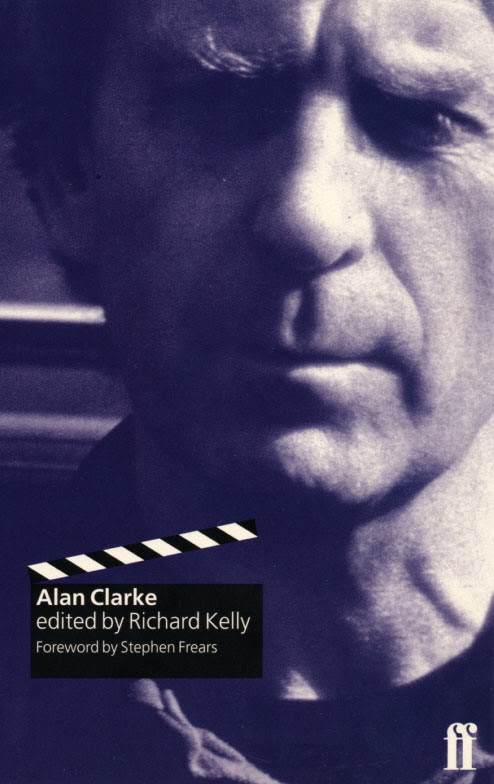
Alan Clarke by Richard T. Kelly (Faber, 1998)

Forgive the past beckoning me in but... it was round about 10 years ago this week that I signed off on the galley pages of my first book for Faber and Faber: Alan Clarke, an oral history of the life and times and (TV) films of the great director of Scum, Made In Britain, The Firm, Contact and many more. In great but needful haste I had begun work in early December 1997, calling on Tim Roth at a production office in Soho where he was prepping his directorial debut The War Zone. I finished the manuscript in March 1998, after 3 1/2 months of crazed gumshoe work, interviewing all round the country. But it was the time of my life, at the time anyway, and an honour to do a hugely improbable book-length tribute to a man whose work I venerated and who seemed to embody most of the good things in the world, as was confirmed by my expert witnesses.
None of the press reviews of the book are online anymore so please excuse the self-absorption of my posting the choicest nuggets up here like so:
“A quite remarkable, heartbreaking book… one of those rare movie books that makes you sit up and start reading… Kelly has had the excellent idea of letting Clarke’s mates tell the story, and he has interviewed everyone he could find, from the women in and out of Clarke’s life, to co-workers like David Yallop and Roy Minton, producer Mark Shivas, cameraman John Ward, actors Tim Roth, Gary Oldman, Ray Winstone and Eleanor Bron. There are more than sixty of them in all, and they’re cut together to make up a bewitching portrait of Clarke… Alan Clarke the book is a model of how to write film history.”
David Thomson, Independent On Sunday
“A sort of oral biography of our television times.”
David Hare, Daily Telegraph
“If there is a better book about British television in the 70s and 80s, I have yet to read it. This extraordinary assemblage of interviews, put together without editorial comment like the printed equivalent of a talking-head documentary, establishes the role of Clarke as friend, mentor and unsung champion of all that is right (and enemy of all that is wrong) with image-based culture in Britain.”
Nick Roddick, Sight & Sound
“Alan Clarke was controversial all his life and yet is hardly known, which is surprising when you read what a funny, untamed, sexy, charming scruff he was. The reason he got away with it was his prolific brilliance as a director. Richard [T.] Kelly’s book is a fascinating insight into a man of difficult, testy and passionate views.”
Angus Wolfe Murray, Scotsman
“Not so much a biography of Clarke as an oral history, Richard [T.] Kelly’s absorbing book depicts an uncompromising hellraiser who tirelessly turned his unflinching gaze on the most controversial subjects. It will make you mourn the passing of a TV industry which fostered work as challenging as his.”
John Wrathall, Premiere
“This is far more than one man and his craft, as the very essence of British culture and politics seeps through the text. A vivid portrait is painted of the unemployment and depression that was to influence Clarke and drive him to leave an anger-fuelled time capsule of society’s injustices for future generations to learn from.”
Dan Rider, Total Film