Showing posts with label richard t kelly. Show all posts

Friday, 4 December 2020

The Snow Ball by Brigid Brophy (Faber)


No appreciation of Brigid Brophy’s fiction could be complete without reference to her passionate regard for Mozart and how she placed him in the all-time pantheon of creative artists. (This was right at the top, ‘on the very pinnacle of Parnassus’ alongside Shakespeare, as she made clear in her 1964 study Mozart the Dramatist.)

Mozart is a presiding spirit through all of Brophy’s novels, but arguably the one that is most thoroughly infused is The Snow Ball (1964), a work that consummately melds Brophy’s deep interests in myth, opera, sexuality and psychoanalysis. Its heroine Anna admits freely to a troika of obsessions: ‘Mozart, sex, and death.’ The Freudian opposites of eros and thanatos, which Brophy considered in her non-fictional Black Ship to Hell (1962), are also shadowy guests in the wings of The Snow Ball.

The novel takes for an epigraph Brophy’s own note from Mozart the Dramatist concerning the age-old critical interest in the question of ‘whether, when the opera opens, Don Giovanni has just seduced or has just failed to seduce Donna Anna.’ In The Snow Ball ‘Did she or didn’t she?’ is turned around to ‘Will she or won’t she?’ as Brophy, with a dextrous touch and allusive skill, brings Mozart’s age into our own.

The setting is ideal for the purpose: an eighteenth-century-themed costume ball on New Year’s Eve, in a London residence so grand as to house a ballroom, home to wealthy Tom and his wife, four-times-married Anne. Anna attends alone, dressed as Donna Anna, unhappily preoccupied by her middle years and what they mean for her good looks, as well as by a general distaste for the occasion. (‘If one wants to forget one’s age’, she will lament, ‘new year’s eve is the wrong eve to start.’)

Like Brigid Brophy, Anna has a highly developed aesthetic sense, and to her keen eye no-one at this ball looks quite right: too many cut-price Casanovas and third-rate Marie Antoinettes. Anna is of the view that people come to fancy-dress balls as their daydreams, and she is pained by the paucity of imagination on display. Yet the judgement she passes on others could be one from which she is willing to exempt herself.

At least one guest at the ball is wearing a mask; and this element of the bal masque makes the vital bridge for the novel into a Mozartian world – the masquerade being, as critic Terry Castle has put it, ‘part of the eighteenth century of the imagination, which in the end is the only one we have.’ A masked ball is usually a subversive occasion, one where feckless acts may suddenly be permitted, and the world turned upside down if only for a night – including the balance of power between men and women, as it is affected by sexual attraction and consenting sexual intercourse.

So, when at midnight Anna meets a masked Don who kisses her on the mouth – ‘not socially, but on the lips, gently and erotically, then with a voluptuous fluttering, and at last with a violent and passionate exploration’ – she is moved to wonder if this mystery man might share her personal obsessions, and whether a closer union is meant to be.

First, though, as if feeling eighteenth-century mores pressing upon her, Anna flees from her suitor, seeking refuge in the sumptuous boudoir of her friend and hostess Anne. It is white ‘like peppermint creams’, done in a style Anna thinks of as ‘tart’s rococo’. There she and Anne share affectionate, barbed gossip and confidences – the reader conscious all the while of a current of erotic tension that will drive the novel toward its finale. 

Anna’s dilemma, though the core of The Snow Ball, is complemented by side-plots. Her kiss with the Don has been observed by Ruth Blumenbaum, teenage daughter of another old friend: Ruth is a precocious diarist who has come to the ball dressed as Cherubino, squired by her disagreeable beau Edward (Casanova). The fitful struggle toward intimacy of these two youths makes for a counter-theme in the novel, as does the slightly unsightly but undeniably contented marriage of Anne and Tom (or ‘Tom-Tom’ and ‘Tum-Tum’, as they call one another in confidence.)

In these parallel amours Brophy makes fine use of her gift for describing human carnality. One evocation, from the female perspective, of what the French call ‘la petite mort’ was thought rather scandalous by readers in 1964, perhaps chiefly because Brophy was a woman and wrote so superbly. And yet Brophy never lets us forget that, however well fitted the partners in this dance, its aftermath can lead nonetheless to thoughts of an entirely different nature. Or to paraphrase Plautus – whom Brophy takes as her other epigraph – even in the midst of the most diverting activities Death may creep up upon us.

This is another tension that persists to the last page of The Snow Ball, where the curtain drops on what is arguably Brigid Brophy's most brilliant fictional performance.

Tuesday, 1 May 2018

The Ministry of Intractable Problems

Amber Rudd MP, now the former Home Secretary

The BBC News Channel kindly had me on yesterday afternoon to talk about the job of Home Secretary and my fictional rendering of it in The Knives. Amber Rudd’s regrettable exit from the front line was the pretext; and the sixth of my novel’s seven parts does indeed describe a ministerial crisis wrought by cascading malfunctions arising from immigration policy, during which my made-up Home Sec David Blaylock must fight for his political survival or else by propelled out of the door – by events, unintended consequences, angry bystanders, assorted ill-wishers etc. 

(Spoiler alert: Blaylock wins the aforementioned battle, partly by outmanoeuvring a broadsheet newspaper determined to oust him, and by physically confronting a leaker within his department. Both of these dramatic turns are, I admit, a novelist’s fancy rather than the products of research.)

Anyhow, this (approximately) is what I told the BBC. 

David Blunkett rightly described it as a job consumed by 'intractable problems'. The job of Home Secretary - whoever’s doing it, of whatever political stripe - seems to me beset by three challenges that tower above all.

1) Because of the huge and burning responsibilities of borders, police and counter-terror, a great swathe of the public have an opinion on how the Home Secretary’s doing, even if they don't know his/her name or indeed anything else about them; and a goodly few are so insistent about what should be done to ‘sort out’ any given mess that you could almost believe they imagine they could do the job better - freelance, as it were, without training or experience.

2) Unlike in the other great offices, at the Home Office your ‘customers’ include a substantive number of individuals who don’t see you as acting for their interests – they don’t want you to succeed in your job (for instance, people who are very well aware that they are in the UK illegally; or people plotting terrorist acts of wickedness against the civilian populace.)

3) The cliché of ‘Events, dear boy’ is truer at the Home Office than anywhere else in politics. As Jack Straw’s ‘Sir Humphrey’, Richard Wilson, told him on the day he took up the post, he needed to enjoy the blue sky outside his window while he could, because an Exocet missile would be headed his way soon enough.

Straw – in his fine 2012 memoir – also stresses that the Home Secretary wrestles with four very distinct factions in order to force through policy, or even just get through the working week: there is the Public, there is the Press, there is the Party – and then there is the Department itself, which has a long history of taking a different view to the Minister, subtly or otherwise, as well as some strange collective sense of its own amour propre. (David Blaylock, while clashing with his own Permanent Secretary, feels a dispiriting perception afloat of ‘successive ministers as mere fly-by-nights passing through a far more solidly entrenched world.’)

I take from Straw that no-one can hope to survive long as Home Secretary unless they have more or less squared away all four of those forces: Public, Press, Party, Department. It’s a truly nerve-straining proposition, and small wonder the job has undone so many gifted, smart and seemingly durable performers. But, the knives are always out for you: you need eyes in the back of your head.

Monday, 18 April 2016

To Belfast, for 'Alan Clarke in Northern Ireland'


This weekend just past gifted me a chance to revisit the work of Alan Clarke and my book about his life and times. The past beckoned me in for more than one reason, too.

I was at the Belfast Film Festival, which was presenting a sidebar of Clarke’s films on Northern Irish themes, and I gave a talk before the screening of Elephant (1988), the 38-minute tour de force that Clarke co-conceived with then-producer Danny Boyle and Steadicam maestro John Ward. The venue was the Queen’s Film Theatre, splendidly refurbished since its amiably distressed lecture-hall ambience in the 1980s when as a teenager I sat and watched Battleship Potemkin and Rashomon and Blue Velvet.

The Festival grew out of West Belfast, and its Feile an Phobail founded in 1988 subsequent to a particularly dreadful passage in the ‘Long War.’ It’s gradually expanded itself into a city-wide offering. The environment is good and buzzy, the programming by Stephen Hackett is superb, and the festival has an admirable commitment to community outreach, also to archival work and introducing the tools of film and their worth to a wider public. On the liaison side I was very well met by and enjoyed the company of Jim Meredith and Sean Osborne. And one great perk of the event was that I got to chat to Jennifer McAufield and Paul Clarke, who actually worked with Clarke on Elephant (as First AD and Designer respectively.)

My lodging in Belfast was the famous Europa Hotel, also vastly improved (for starters we drove right up to the door and I walked straight in) since Clarke and Ward stayed there in 1988 during the production of Elephant: I recall John Ward describing to me the inevitable bomb scare he and Clarkey endured back then, the precautionary piling of mattresses against windows by staff, the plying of guests with free booze as if to stiffen resolve.

Belfast's Europa Hotel, April 2016
If you stroll the centre of Belfast now the surface effect of years of peace dividend are clear; also the fruits of how much European money underwrote post-conflict reconstruction. That said, the visible campaigning for the Stormont elections in May would remind you that politics there retains a whole horde of familiar hostilities. And you don’t seriously assess the health of a city by its main commercial thoroughfares, agreeable as they are these days.

But, be there no mistake, it’s only one of a million things that speak well of the political processes of the last twenty years – and the resultant opening-out of the society – to say that all sorts of films can now be made in Northern Ireland. I only wonder what kind of film Alan Clarke might have made in Belfast today, had he lived?

Moreover – you see I did some thinking – how was it that back in the 1980s Alan Clarke became such a voice on the subject? Fair enough, quite a few of his contemporaries (Loach and Leigh inter alia) came to Belfast and made films: it was obvious, pertinent, arresting subject matter. But Clarke’s Northern Ireland films aren’t like anyone else’s. They’re pretty exceptional in the history of film, full stop.

Here’s the thing, in my view. The 1980s are when Clarke began to evolve from the loyal, driven collaborator of writers like Roy Minton and David Leland to being an auteur of the TV play: a director who put his signature on the work through formal choices with the camera and in the cut that were so bold that the script began to seem only a point of departure. And Northern Ireland by the 1980s was increasingly a terrain for storytelling where traditional three-act narrative looked inadequate to the thorny reality – the issue of what side you came down on leaving the filmmaker liable to run into dramatic dead ends just as implacable as ‘peace walls’.

Clarke, moreover, saw things with a different eye; and it was useful that he didn’t hew to an ideological line. I remember asking Roy Minton what were Clarke’s ‘politics’. Roy replied, ‘He didn’t have any... I was Left, and it got as bad as joining The Communist Party. But what Alan had was the indignation, he recognised injustice.’   

Psy-Warriors (1981)
Of the three Clarke films showing in Belfast, David Leland’s Psy-Warriors (1981) has aged least well, I’d say. Its premise is that three suspected terrorists are being interrogated in special cells following a pub bombing near Aldershot army barracks that bears the hallmark of the IRA. The viewer isn’t spoon-fed this information: the film is aggressively disorienting in its use of sound and space and cutting, Clarke wants you to feel a bit of the deranging nature of interrogation. Leland had been inspired by Peter Watson's book War on the Mind: The Military Uses and Abuses of Psychology

Gradually you sense Psy-Warriors really wants to advance an idea of a symbiotic relationship between governments and terror threats, as oft inferred from Reginald Maudling’s infamous line about an ‘acceptable level of violence’ in Northern Ireland, and the attendant theory that the six counties were a kind of policy laboratory for the security forces of the British state. Colin Blakely, the late great character actor from County Down, is very good as the chief interrogator. Yet when he speaks in high solemnity about the rationales of the Baader-Meinhof gang, you can feel the film’s intended critique of the repressive state succumbing to the fallacy of taking all self-declared revolutionaries on their own terms. If violence is really to be read as a kind of communication, you’re best to read what it’s really saying with some care.

Sean Chapman as the commander in Contact (1984)
Contact (1984) is my favourite among Clarke films, but it travels some way from its source material, which is A.F.N. (‘Tony’) Clarke’s memoir of commanding a paratroop patrol on border duty in Crossmaglen in 1976. Tony Clarke certainly wrote a script, and the film extracts a concentrated essence of something that strikes you on the page of his book: the loneliness of command when leading men on hazardous operations against a largely invisible enemy in ‘bandit country’. But Alan Clarke’s film replaces Tony Clarke’s frank, unleashed, first-person voice with the sense of the camera at a remove from the fray, an austere God’s-eye observer, as close to birdsong and trees and to carpets of green field as to the soldiers moving warily across them – at least until ‘contact’ occurs, at any rate.

Clarke had his cast drilled within an inch of military discipline, and during the shoot he steadily pared away the script’s exposition and dialogue. He put long lenses on a moving camera and the actors began to lose that sense of the line between being ‘on’ and ‘off’, such that they just behaved as soldiers like they’d learned how to. For the viewer it becomes redundant to ask whether Contact is sympathetic or otherwise to the presence of the British Army in South Armagh. To appreciate the film properly you just have to try to walk a mile in a squaddie’s boots. Contact is as pertinent a study of soldiering now, in the age of the Three-Block War, as it was in 1984. But it’s just masterful filmmaking by any measure. According to John Ward, who did time on Full Metal Jacket and Eyes Wide Shut, Stanley Kubrick was a big admirer of Contact. And Kubrick knew about war films.

From Elephant (1988)
Elephant (1988) is unique and unclassifiable. Ironically, Danny Boyle arrived in Northern Ireland as a BBC producer with the express aim of encouraging writers and dramas that weren’t inexorably bound to accounts of paramilitary killings. He shepherded scripts by Paul Muldoon, John McGahern, Anne Devlin, Frank McGuinness – and those films were all very different and distinctive. But Boyle really wanted to work with Alan Clarke, whom he revered, and it just so happened that what they did together emerged as the ‘Troubles’ statement to end them all.

Clarke and Boyle resolved to present a series of fatal shootings, with no context or dialogue or identifying marks. Clarke and John Ward figured out how and where to film these, like a sequence of short films, two a day. Once in the can they were laid end to end, ‘a remorseless way of presentation’, as Boyle described it to me. Clarke would re-jig the original running order, and he left out a couple of pieces he’d shot. But you can’t really imagine any other final cut of this film.

Some of the killings happen swiftly and starkly, on a doorstep, in a car-park or a petrol station forecourt. More breath-catching ones that build up anticipation and dread occur in a swimming pool and a municipal park. There’s no slack: each assassin shoots straight then makes their escape. But it does get steadily more upsetting. You start to watch each new scenario and think, who is the gunman here, who the victim? Or from which edge of the frame will the threat appear? And can nobody escape their seeming fate? That feeling is especially acute in the sequence where two gunmen, one with a shotgun, stalk a victim who makes a hopeless effort to crawl to safety after sustaining a leg wound. The final sequence – an enigma – depicts a man being escorted through a deserted factory to the site of his own execution.


It’s an obvious thing to observe that Elephant is a film about a ‘cycle of violence’, with that degree of pained futility about it. One or two commentators, I think, have linked it to a later endeavour, the great literary obituary of the Long War, Lost Lives (1999, ed. McKittrick et al); but then that book makes very clear that murder was something inflicted on over three thousand named individuals in very specific places, and that those people had life-stories of their own. The subject of Elephant, though, is just the process of cold-blooded killing; and your mission as a viewer, should you choose to accept it, is to ponder that subject – in the dark while the thing unspools, and in your head afterward once the lights have gone up.

For me it was certainly a thing to watch it and think about it one more time in Belfast, 28 years - but only a short walk away - from where it was made.

Tuesday, 8 March 2016

The BFI's 'Complete Alan Clarke'

The late Alan Clarke is one of those artists whose reputation is like a rumour, or a challenge. The body of work is attended by controversy, and those in the know tend to say that no-one did it better or tougher than when Clarkey did it – the ‘it’ in question being plays for television, the ‘when’ being the dramatically rich era of the 1970s and 1980s.

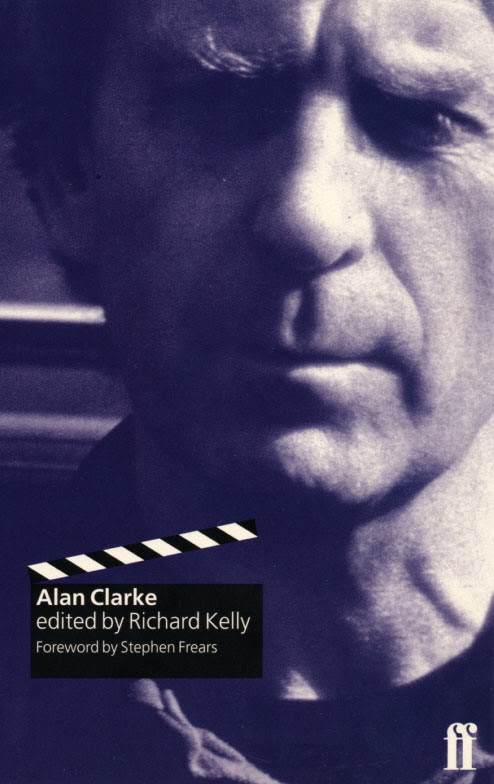
I’m always keen to have a hand in spreading the good word about Clarke. In 1998 I wrote his biography for Faber and Faber, my first published book. I say ‘wrote’ but it was really a work of oral history, George Plimpton-style, where I interviewed a wealth of his friends and family, collaborators and lovers, and stitched those transcripts into one multi-vocal life story. And I daresay Clarke’s life tells you as much about Britain, class and society in those years as his films do. My favourite review of the book, you’ll not be surprised, is this one by David Thomson, he of the Biographical Dictionary of Cinema, who was a big early champion of Clarke among the film-critical fraternity.

Now, Clarkey fans are living in exciting times, because at the end of March the BFI will start rolling out a huge tribute, ‘The Complete Alan Clarke’, with events and screenings at the South Bank and a comprehensive DVD/Blu-Ray boxset. There have been other such celebrations since Clarke’s death in 1990 – I helped Lizzie Francke and the Edinburgh Film Festival with one such in 1998 – but the BFI platform gets a huge boon from having the Clarke oeuvre packaged up so marvellously in one collectable digital set. 

Sam Dunn at the BFI has been the overseer of this great undertaking, and I’ve been happy to chip in a few embellishments to the boxset: new essays on Road and The Firm for the booklets, and an audio commentary with national-treasure actress Janine Duvitski for Diane, one of Janine's earliest screen roles, possibly her best. My book is going on sale again, and I think I’ll be giving a public talk or two once the season goes out and about countrywide.

Looking again at just a few of Clarke’s films I was pleased but unsurprised that age doesn’t wither them, because they were made with such care and conviction, such focus and force. Clarke was only interested in strong-meat subject matter, and he cut to the bone and cast aside the fat. I would love to see what new audiences will think and feel as they come for the first time to Penda’s Fen or Made in Britain, Scum or Elephant, Contact or Christine, et cetera.

Working on the book was a very happy time for me, one I owe to Walter Donohue, editor of the Faber film list who had input in that moment from the brilliant soon-to-be award-winning filmmaker Kevin Macdonald. It was late November 1997 when Kevin gave me the green light to start writing Alan Clarke – on the proviso that I deliver in March 1998 so that finished books could be ready for Edinburgh that summer. I made it, just, having met about 70 remarkable people over 16 weeks, some of them now gone, alas – such as producer Mark Shivas, cameraman John Ward, and the great Brecht scholar John Willett, who helped out Clarke and David Bowie with their remarkable Baal.

One of my treasured souvenirs from publication was a handwritten letter sent me by Christopher Eccleston, who wrote to say that Alan Clarke was the whole reason he became an actor, and that he felt my book ought to be set reading in all British film and drama schools. Well, what a lovely thought, and I wouldn’t fight it, you understand… The book, though, is only a useful companion to a body of work that ought to be required viewing for anyone who respects film. One good friend of Clarke's among my interviewees, typically mischievous, told me he thought I ought to become ‘Professor of Alan Clarke Studies at the University of Scum.’ Well, if that were the badge I’d wear it proudly.

Postscript: One of the trickier parts of biography is conveying the sense of humour of one's subject, especially if that person was/is routinely said by those who know them to be 'very funny' in person. Everyone I met thought Alan Clarke was really, really funny, and I could see why. The challenge, then, is how to adduce the right examples of witty remarks, behaviour etc so as to encourage the reader to imagine all the fun they'd have in such company. (I had the same challenge down the line with Sean Penn, who's also really funny.) 

The trouble in the case of Clarkey was that the examples my interviewees tended to offer me were either a) things that didn't work on the page, such as puns and other bits of verbal dexterity, or a certain way of looking at someone, or b) things that were, at least in the opinion of my manuscript's early readers, un-printably rude/filthy, even if in good sport. So most of those gags hit the cutting room floor... but they were certainly funny at the oral stage, in the telling and the hearing, and I do sometimes share them with other Clarkey fans in the right circumstances, i.e. when propped up agreeably at 'Mahogany Ridge'.

Wednesday, 24 February 2016

Robert Harris on The Political Novel @ the LSE


In 2009 I reviewed Lustrum, the second of Robert Harris’s 'Cicero Trilogy', for the Financial Times. Praising Harris’s ‘distinctive excellence’, I wrote that he ‘understands politics and how to dramatise them: their necessary imperfection, their dependence on the embrace of lesser evils and shabby means that serve higher ends.’

Last night I went along to the LSE Literary Festival to hear Harris talk with Peter Kemp of the Sunday Times on the theme of 'The Political Novel' – an event organised in association with the Royal Society of Literature. Harris’s ability to discuss his working process, his view of the world and how he conceives his fiction is matchless in its assurance. As a huge Harris fan, and having spent the last few years writing and researching my own novel of politics The Knives (forthcoming from Faber this August) I could hardly have passed a more thoroughly engrossing ninety minutes. My notes from the evening are as follows:

1. In his early twenties, having been president of both the Cambridge Fabian Society and the Union, Harris contemplated seeking selection as a Labour MP. But he came to the view that the ‘modes of thinking’ for a politician and for a writer were too far apart, and that he preferred the latter. Having done that much hard thinking, though, he readily admits still to a ‘sneaking sympathy’, an ‘instinctive empathy’, for working politicians. He told the audience in tones of relief that it was some peoples’ jobs to get up in the morning and think about Brexit or the junior doctors, but not his.

2. He was shrewd and amusing about his early career path: how, post-Cambridge, having set himself on journalism, but having come from ‘the provinces’, he had no intention of going back there to serve a necessary Fleet Street apprenticeship; and so went for and secured a BBC traineeship. Later he was again acerbically funny in pointing out that, while his path through university and media would have made easy enough material for the sorts of English novels “that have been written by others” he felt this was inadequate material for good fiction.

3. In digression, some of his liveliest tales concerned his association, beginning at Cambridge, with the ‘controversial’ historian David Irving, who certainly knew that the so-called ‘Hitler Diaries’ were a forgery. I was reminded of Christopher Hitchens’ account of the kind of hair-raising ‘wit’ a writer will expose himself to if keeping Irving’s company.

4. Harris was fascinating on how his bestselling fictional debut Fatherland began as a non-fiction project, ‘a Baedeker guide to a world that never existed’, until he realised the freedom he needed to start making things and characters up.

5. Also v intriguing: his description of how, instead of Pompeii (2003), he nearly published – spent quite some considerable time on – a dystopian novel about an America whose politics fall under the sway of a Disney-like corporation. Clearly he chose well to jack that US-set book in and find another imaginative way to write about an empire under threat.

6. His two big tips for an aspiring novelist? 1) Have some sense of what your ending will be, where you are heading, even if you detour along the way. 2) The point-of-view of the narration determines everything.

7. An additional tip for the thriller writer: have a tight time-frame. Then shorten it.

8. Really fascinating for anyone who knows cinema (i): Harris talked about admiring and wanting as a novelist to emulate the film directing career of Stanley Kubrick, who, he felt, ‘could do any place.’ I suspect this wish is rather a common one.

9. Really fascinating for anyone who knows cinema (ii): Harris was very funny about his collaborations with Roman Polanski – to wit, how he sent Polanski the manuscript of An Officer and a Spy (the idea of a Dreyfus project Polanski had, after all, initiated), and then received copious notes on his prose from the maestro down the telephone.

10. Asked if he would contemplate a contemporary Westminster-set novel, comparable perhaps to the works of Trollope (which Harris ‘loves’), he admitted to some reluctance – that the Commons is no longer the most powerful legislator in the world as in Victorian times, that the drama and the stakes are just not the same. That said, he was surprisingly passionate – surprising even himself perhaps – when he talked of the drama he discerned in the ‘coded battle’ that had taken place in the House just the other day between David Cameron and Boris Johnson; and he evoked the ‘Shakespearean’ falling-out of the Miliband brothers and ‘what had happened to the Labour Party’ because of it.

11. Asked for his thoughts on political fiction that emphatically set itself on one ‘wing’ of a political argument, Harris was emphatic, saying that he felt for a novelist to try to ‘animate an ideology’ was a ‘fatal move.’ Though a Labour supporter still, he made clear: ‘I can’t believe that virtue is all on this side.’ This is as near as dammit a quotation from Trollope, and an eloquent gesture from one master of the form to another.

12. In my view Harris's early non-fiction works should be read just as keenly as his novels, for all that he has firmly chosen the latter camp now for his output. But at one point last night he looked a little wistful in remarking that his The Making of Neil Kinnock (Faber, 1984) is probably 'not much read these days.' It should be read by anyone interested in British politics - "now more than ever", perhaps. 

Tuesday, 28 April 2015

Kafka's The Metamorphosis: It Lives, Again...

Kafka postcard, available at zazzle.co.uk
If Franz Kafka were living today do you suppose he could get a start in the writing game, recessive type that he was? You’d hope so; but then it is a self-promoting business, not ideal for one who reviewed his life’s work and concluded that the bulk of it ought to be consumed by fire. On the one hand it’s hard to imagine Kafka on Twitter; yet undeniably the man had a gift for aphorisms. 'In the struggle between yourself and the world, back the world' – that’s 65 characters right there.

Kafka’s The Metamorphosis (Die Verwandlung) turned 100 this year. At least, 1915 is when it was published, which is to say finished; and Kafka, of course, didn’t finish all that much. He did the main work on the story in the autumn of 1912 and completed a version of it on December 7 of that year. However, negotiations with publishers were complicated, and circumstances – inter alia The Great War, during which one prospective publisher (Robert Musil!) was called up, and another stopped printing – got in the way. But in 1915 it finally appeared, and has since come to be considered among the most famous, and greatest, short stories in the history of literary fiction.

On this centenary occasion I’ve had the pleasure of writing a long preface to the reissue of a rare translation of The Metamorphosis by A.L. (Albert Lancaster) Lloyd (known as ‘Bert’), which was, as of 1937, the first complete single-volume English version. (Lloyd, a folk musicologist, singer, arranger and author, was a key figure in the reflorescence of English folk music after the Second World War.) You can buy this edition as a Faber Find priced £4.99. 

Meanwhile BBC Radios 3 & 4 are about to launch a major commemorative celebration of Kafka's work, for which playwright Mark Ravenhill has written a new adaptation of The Trial. Mark and I were on Radio 4's Open Book last week talking to Mariella Frostrup about Kafka's imaginative genius, his women troubles, and his great and strangely neglected sense of humour. It starts at 13:16 if you follow this link.

Myths have accumulated around Kafka, largely because they are compelling myths, and this is one of the greatest of writers – as George Steiner has argued, perhaps the only author one can be thought to own a letter of the alphabet. Kafka made his own world on the page – recognizable but not quite real, precisely detailed and yet dreamlike – and it still feels original and hugely influential. Once you know that world, you do tend to see it around you.

Though his great fame was posthumous Kafka did have a reputation to speak of during his lifetime. Something else that happened in 1915 was that the winner of the prestigious German-language Theodor Fontane Prize, dramatist Carl Sternheim, bestowed his prize money upon Kafka as a mark of writer-to-writer respect. (Imagine a Booker Prize winner today declaring from the dais that he wanted to hand his £50,000 to another more deserving scribbler.)

One danger with great writers, though, is that you can stop reading them, and so lose sight – or retain only a stale notion – of what constituted their greatness. The trappings of the ‘Kafkaesque’ are easily recalled, especially the sense of an individual at the mercy of a big impersonal bureaucracy, feeling after a while that he can’t but take it personally, and haunted by the sense that perhaps, after all, he deserves it. And anyone who has glanced at Kafka’s biography knows about The Father: Hermann Kafka, strapping son of a butcher, ex-serviceman and purveyor of fancy goods, against whom Franz (Hermann’s only son) felt inadequate in every way

Certainly Kafka suffered neurotic misery, but then that is the making of many a writer. In his case he seemed to feel it could be no other way and probably ought to be so: writing, he decided, was to be in ‘the service of the Devil’, a pact that never turns out in one’s favour. (As he wrote in a letter of July 1922, two years before his death from tuberculosis: ‘I have not bought myself off by my writing. I died my whole life long and now I will really die. My life was sweeter than other people’s and my death will be all the more terrible.’)

But Kafka, though a wounded man, wished nonetheless to make an exhibition of his stigmata. And there’s something almost chilling in how he could step aside from himself, perceive his own plight, and twist it with such finesse into supple fictional shapes that had the force of parable.

That’s only the bare scratch of a start, though, in all one might say about Kafka. Revisiting him in order to write about him I was struck anew by how many stories he composed from the perspective of creatures: Investigations of a Dog, A Report to an Academy, Josephine the Singer, The Burrow. Simply put, it’s as if Kafka were saying, ‘You’re in the body you’re in, it makes the problems it makes, and the soul protests its fate whatever.’

Josephine and The Metamorphosis were recently re-imagined for children in My First Kafka: Runaways, Rodents, and Giant Bugs, written by Matthue Roth and illustrated by Rohan Daniel Eason. I find this a pleasing and fresh turn in the more tired anthropomorphic bent of books aimed at kids. But that’s not to say the original wouldn’t work for them. For instance, I began composing my Metamorphosis preface beside a swimming pool during a family holiday last summer, and at one point a nine-year-old friend of my elder daughter picked up my old Penguin edition of Kafka’s original and started to question me about it, closely and with mounting curiosity. I like to think she had sensed something wise - sacred, even - in those pages. Kafka will tend to make you feel that way about books - such was his presence, now, then and, one somehow imagines, always.

Friday, 10 April 2015

My course in Non-Fiction Writing at The City Lit: April 24 - July 10 2015


From April 24 to July 10 I'm going to be teaching a class in Non-Fiction Writing at the City Lit in Covent Garden. Simply put, this will involve me and the students reading and appreciating the works of some high-order exponents of contemporary non-fiction, and the students producing their own written work for class discussion on a weekly basis. I think it'll be fun. Anyone is welcome to book a place, please do tell your friends etc.

Among the writers whose work I expect we will be looking at are:

Simon Armitage (Walking Home)
Gordon Burn (Somebody’s Husband, Somebody’s Son)
Ian Buruma (Murder in Amsterdam)
Roger Deakin (Waterlog)
Joan Didion (The Year of Magical Thinking)
Ian Hamilton (In Search of J.D. Salinger)
Robert Hughes (The Fatal Shore)
Janet Malcolm, (The Journalist and the Murderer)
Norman Mailer (Miami and the Siege of Chicago)
V.S. Naipaul (Area of Darkness)
Gitta Sereny (Cries Unheard)
Claire Tomalin (The Invisible Woman)

Among the issues I imagine I'll be exploring with the students:

- Structure, narration, point-of-view; 
- how to work up your inchoate ideas; 
- how to be honest on the page; 
- how to explain the way that a thing works; 
- how to describe what people and places look like; 
- how to convey the ways people speak; 
- how to explain a sequence of events interestingly; 
- how to fathom one’s memories accurately...;
- ... and how not to fabricate them; 
- how to bear witness to human misery;
- how to write about people and things of which you disapprove; 
- how to keep good notes, how to conduct interviews; 
- how to begin a piece of writing; 
- and, oh yes, how to end it.