Showing posts with label peter gabriel. Show all posts

Monday, 25 October 2010

In Praise of 'Temptation'

Flying Virgin Atlantic last week I had a choice of 60 movies on the small screen before me, and I must have watched 5-10 minutes each of a dozen of 'em, mainly to see how the special effects turned out. (Quite some Medusa in the remade Clash of the Titans, I must say...) But if one was a passenger in search of some drama, oriented toward grown-ups (i.e. not Adam Sandler in Grown-Ups), it was rather a hard hunt.

I watched all of Martin Scorsese’s Shutter Island, and that wasn’t the wisest idea, since I get a bit over-sensitive at 35,000 feet anyway, and this is a movie that relies heavily on the image of three small children lying face-down-drowned in a lake. Shutter Island was impressively done in its own stormy psycho-noir Dennis Lehane way, and I wouldn’t be so crass as to say any old hack could have made it. But there’s probably a long-list of younger and less brilliant directors who nonetheless might have given it a good shake. Whereas Martin Scorsese is 67 years old, a lion.

Anyhow, so: I de-plane, then flash-forward to my New York hotel room where I lie awaiting the sleep that I missed while flying. Flipping the 200 channels on my TV I stumble on one showing Scorsese’s 20-odd-year-old film of Kazantzakis’s The Last Temptation of Christ. Now there’s a movie that could only have been made by the respected firm of Scorsese/Schrader: an incredible treasure, of the sort they don’t make anymore (but, let’s face it, had to struggle very hard to make in the early-to-mid-1980s.) I don’t hesitate to award it the Capicola Cup for Personal Favourite Scorsese Movie.
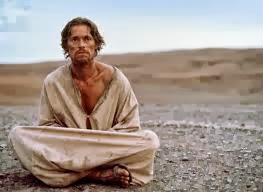
Sceptics may think it resembles nothing so much as a troupe of Manhattan thespians, musicians and mime artists on tour in Morocco, shepherded by a director who’s only been allowed one day’s shooting with his beloved crane (but sure is making the most of it.) Still, I think anyone who lets themselves sink into the movie’s peculiar rhythm would have to admire it. For one thing, that rhythm is underwritten peerlessly by Peter Gabriel’s glorious score. But then just the performances, even. Willem Dafoe elegant and anguished as ever was (since when he’s often seemed to be acting in a foreign language.) Barbara Hershey, whose idea the whole thing was, exquisitely witchy as Mary Magdalene. Andre Gregory’s stark-eyed rail-thin John the Baptist, David Bowie unbelievably pitch-perfect as Pilate.

The picture reaches one form of climax in the Golgotha sequence, all stony, bloody desolation, Dafoe wearing the thorniest of crowns. But the best is all to come, the titular ‘Last Temptation’. As Paul Schrader put it, ‘The greatness of the book is its metaphorical leap into this imagined temptation; that’s what separates it from the Bible and makes it a commentary upon it.’

This is how I describe the film’s final half-hour in Ten Bad Dates With De Niro:
  “… abruptly the Nazarene finds the noise gone mute all around, and his gaze falls on a perfect little blonde girl [Juliette Caton] who beckons him down. Calling herself his ‘guardian angel’, she has golden curls, a full mouth and a Roman nose. She offers him the life of a normal man, assures him he has already suffered quite sufficiently for his Father’s purpose. She sits serenely outside the dwelling as Jesus and Mary Magdalene make love, blesses their marriage, and consoles him when Mary dies in childbirth. She watches over his patriarchal old age, and steers away from that troublemaker Paul (Harry Dean Stanton.) It’s only when Jesus is visited on his deathbed by a bitterly anguished Judas Iscariot (Harvey Keitel) that this ‘angel’ is called by her true name: for the last temptation is domesticity, and in short order Jesus is renouncing Satan and begging to be set back upon the upright…”
 That reminds me of what are probably the film’s two most powerful performances, even in the midst of that stunning array: flame-haired Keitel, passionately dour as a radical Judas, and Harry Dean Stanton, quite, quite phenomenal as Saul of Tarsus, he who became Paul. In the clip below Harry Dean is so good I almost want to pick up my mat and follow him.

Thursday, 22 January 2009

Oscar Nominees: Good Work, Fellas

Not Oscar's nominees, no, per the photo - but then I know that AMPAS are protective of any and all reproductions of their famous statuette, whereas I do hope Sesame Street are happy to see Oscar the Grouch show up anywhere, as I certainly am and as I imagine those two tourists were too...
No, ordinarily this blog finds it best to yank down the earmuffs and the eyeshades round Oscar Nominations time - an announcement that only marks the end of one round of Drivel being talked across All Media, prior to the commencement of a fresh Drivel festival. But, having glanced at this year's noms list, with a special interest in one or two parties, I have to say I can't remember a year when so many of the Good Guys seem to have won (if you consider the taking-part as winning, which sadly most people don't...)
One can't but be pleased, for example, to see Werner Herzog and Peter Gabriel both getting recognised. Will they both go to the ceremony? They should ride in the limo together, talk about some stuff on the way... Elsewhere, good to see two pictures highly praised at Cannes - the gentlemanly Laurent Cantet's The Class, and Waltz With Bashir - go into the Best Foreign Film pot. I would imagine Danny Boyle, Simon Beaufoy and Anthony Dod Mantle will be a gang for the night as part of the Slumdog Millionaire set, and it seems to me they deserve all the praise in the world for their respective inspired inputs to that picture. This blog need say little more on the subject of Sean Penn and Milk save an extra hearty congrats to Gus Van Sant, who served a long stint on this project, and to Focus Features. And I imagine the 13 nominations for The Curious Case of Benjamin Button must be close to some kind of record? I'll be writing about that picture at length elsewhere, but as with the others above, I think in this case the recognition and applause for the quality of the filmmaking is deeply, deeply deserved. As it so often isn't...

Saturday, 28 June 2008

Peter Gabriel: The Rhythmatist

Last weekend me and my family had the great good fortune to stay a few days in the country cottage of one of England’s finest composers. Quite apart from the lovely living arrangements, I even got to do a little writing in his office, having carefully cleared a space to spread my things, between the piano and the sheets of notation and the pocket metronome… The bookshelves in the cottage were fairly choice too, replete with good fiction and non-fiction, but I was especially interested in the selection of books on music. Typically, though, I zeroed in on a volume called Good Vibrations, about the history of rock/pop production techniques.
One section therein that grabbed me concerned the introduction to musical possibilities c. 1980 of the Fairlight, an early sampler which loaned itself to terrific aural experimentation. The first two musical types to invest their own money in this expensive device in the UK were Peter Gabriel, and Durham’s own Trevor Horn. And I remember, as if it were yesterday, the autumn/spring of 1982-83, running out to three separate long-playing records (vinyl, of course) that made stunning use of the new technology: Kate Bush’s The Dreaming, Peter Gabriel’s fourth self-titled solo album, and Malcolm McLaren’s Duck Rock, produced by Horn. (That last one, an early experiment in world music piracy, had some marvellous tracks, only partially marred by the presence of McLaren himself, such as the juju-inspired Soweto.)
Prior to those bits of shopping one of the big musical revelations of my young life was in late 1982 when I saw a South Bank Show on the recording of aforementioned Peter Gabriel IV. The picture it presented, enforced by amazing music, of Gabriel’s genius-like marrying of rhythmic and melodic and lyrical/cerebral qualities, was incredibly powerful to an impressionable youngster. I suppose I was particularly gripped by the description of how Gabriel’s bookish idea for a song provisionally titled ‘Jung in Africa’ became this thunderous track, The Rhythm of the Heat.
A few years later Alan Parker persuaded Gabriel to remodel the IV songs and a few others from his back-catalogue into a score for Parker's movie of William Wharton’s novel Birdy. This Birdy trailer - which also brings back a horde of memories for me in the proverbial Proustian rush - is a showcase for some of Gabriel’s choice cuts and the imagery of the film to which they were terrifically matched.
As it happened, Alan Parker went on to do me a couple of great good turns in life which I won’t ever forget. Gabriel, meanwhile, has remained one of my absolute favourite artists. This weekend I note there’s a new release forthcoming from Gabriel and Real World – Big Blue Ball, essentially a record of some diverse and glorious jam sessions at Gabriel’s studio over various summers 15 or so years ago. I’ll be buying that one, then.