Sunday, 14 November 2010

666: The realm of nasty numbers


At one point in his recent (rather interesting, distinctly personal) documentary study of horror films for the BBC Mark Gatiss sat down with David Seltzer, author of The Omen (hit novel and film), and put to him the big question: does he believe in the Devil? Seltzer wryly replied to the effect that if he did, then he wouldn’t for one moment have messed about writing books that presumed to speak of Him and His powers.
That’s funny, and fair enough. As Gatiss noted, Satan was a hot thing in 1970s Hollywood after the success of Rosemary’s Baby and The Exorcist. And Seltzer had a good nose for how to do something new and commercial with the Evil One. Of course there have been repeated and not wholly unfounded attempts to argue that various cast/crew members on The Exorcist were afflicted by a sort of curse in subsequent years. But it doesn’t seem that David Seltzer’s had to worry – has suffered no freak impalements or decapitations, rather, enjoyed the fruits of his labour, his imagination.
The Omen was on telly again the other night and I made the mistake of watching bits of it. God but it’s a thoroughly professional, expertly-managed, big-budget piece of depressing nastiness. (Seltzer was quick to tell Gatiss he felt Gregory Peck loaned a weight to the project that Charles Bronson - the original casting as the US Ambassador to the Court of St James - couldn’t have.) Actually I remember the film’s network TV premiere on ITV at some point in the very early 1980s. I’m sure I wasn’t allowed to watch it all but I saw enough to be feel a kind of outrage over a picture in which the baddies were so clearly being allowed to win.
Still, I must admire the gruesome effectiveness in places, and the power of the imaginative concept. I was talking to a filmmaker friend the other day about the Gothic-supernatural-steampunk trends in film, and apropos Guy Richie’s Sherlock Holmes (which we both admired hugely) he mentioned how much he prefers the sort of 'mystery & imagination' movie wherein events of a seemingly supernatural origin are later revealed to be in fact the cunning/fiendish works of man. With The Omen, you could choose to look at the narrative from a remote vantage and say that all those killings are just a chain of freak accidents and fatal misunderstandings, wrapped around a fat-cheeked piggy-eyed little 5-year-old boy... (That said, in the yet more laboriously nasty sequels Damian and The Final Conflict the maturing Anti-Christ took an active hand in murder, using sorcery to do so, so the game was up by then.) Still, such room for ambiguity may explain why the Polish sociologist Zygmunt Bauman once put his name to a paper entitled ‘The Exorcist and The Omen, or Modern and Postmodern Limits to Knowledge.’
Movies speak of their times and The Omen is unmistakeably the drear England of the mid-1970s, the sort of place where Satan might well seek admission to the affairs of men. (Just as The Exorcist is well located amid OPEC crisis/Watergate-era Georgetown.) Having stage-trained Brits such as Billie Whitelaw and David Warner and Patrick Troughton in the cast gives The Omen the faint air of a BBC 'Play for Today' or some gritty Royal Court production, though here the smart actors are employed only in order to be killed off in horrible ways. (The 2006 remake of The Omen was also on telly last week, and I couldn’t face it, assuming it was done purely to cast younger leads and find more hi-tech ways to kill smart actors – Pete Postlethwaite, David Thewlis etc – horribly.)
In fairness to The Omen, it bravely makes no effort to endow Satan and Satanism with any sort of perverse allure, any suggestion of luxurious darkness or forbidden pleasure in the act of pledging one’s soul to Satan. You just have to take in on trust that Billie Whitelaw’s Mrs Baylock is committed to the Anti-Christ just as some people are to Labour or the Tories. She wants a strong leader in charge and she’s grimly prepared to roll up her sleeves and do the dirty job of getting him there, shoving people out of windows if needs be, though it’s hard to see what will be her personal reward for same. In Damian, sequel #1, Lee Grant is burned to death shortly after murdering her husband in a misguided show of loyalty to Satan’s son. In The Final Conflict, as I recall, a whole network/cabal of suburban English salarymen and housewives were revealed to be in joyless thrall to the Deceiver. And that's a powerful dramatic idea, one that allows a dramatist to reveal any character as being, quite suddenly and without apparent motivation, capable of the most appalling/malevolent act. Nasty, as I say...

Monday, 8 November 2010

#9: The number of the Beast

Is it only 18 months since I sat there most weekends worrying whether Andy Carroll had adequate goals and technique in him for the 'top flight', rather being just another of those Academy nearly boys...? It's the Rooney/Walcott syndrome, 'they need to show they've got it before their 18th birthday' etc. Well, as of today the Bensham Battering Ram looks set for a first England cap. Not that I care, indeed I'd rather he kept clear of all that muck, but then there are distinguished precedents for the national team being spearheaded by pure Geordie instinct for goal... As long as Big Andy comes back from his little holidays safe and well and ready to do it all again for NUFC...
Mind you, Carroll does give the air of being impregnable as well as often unplayable. 'He's a beast', said a West Ham mate of mine during the Boleyn game of a fortnight back - said so not quite admiringly neither. And Carroll's off-the-pitch manners are a big matter for concern, no question. But as Arsene Wenger put it in his programme notes on Sunday, 'Andy Carroll has stature, charisma and quality...' Over 90 minutes on the park, in other words, he is exactly What The Boys Want.
Photograph: Stephen Pond/EMmpics Sport

Thursday, 4 November 2010

"Kelly made editor at Faber Finds"

Ah-ha. This is the second time in a fortnight I've had the good fortune of my activities being reported upon by the Bookseller's Charlotte Williams. (This news was also lead item today on the industry subscription site Bookbrunch, if only for a day, but still...) This is how the Bookseller wrote it up:
"Faber has appointed author Richard T Kelly as editor of its print on demand imprint, Faber Finds. Kelly succeeds John Seaton who had headed up the imprint since its launch in June 2008. Kelly's first novel Crusaders was published by Faber in 2008, with his second, The Possessions of Doctor Forrest, to appear in June 2011. He has also written and presented television documentaries, and has contributed to a number of national newspapers as well as being a notable blogger (http://richard-t-kelly.blogspot.com).
Richard T Kelly said: "Like a great many writers and readers I was in love at first sight with the concept of Faber Finds as an expanding library of literary treasure, and so I'm very excited now by this opportunity to build on John Seaton's work, to keep on restoring brilliant books to their natural readerships, and also to ensure that Finds establishes an online presence that draws all interested readers and writers into a passionate discussion of our literary culture."
Stephen Page, Faber c.e.o. and publisher, said: "Faber Finds has always been about offering a service to authors, a way to make the wealth of their backlist titles available and to keep them available in good company. As Faber Finds builds on its early success and fast growth, it is wonderful to have an acclaimed writer with publishing experience at the helm."
Faber Finds has so far brought about 750 books back into print, with 250 more schedule through 2012. Recent successes include reissues of John Julius Norwich's Norman histories and Michael Foot's Aneurin Bevan."

Wednesday, 3 November 2010

Bookhugger column #8: What Our Kids 'Should' Read

My October Bookhugger column went up last week, so this is a belated nod, but in a sense I was distracted somewhat by it having elicited one or two comments, which are, after all, what we live for... The nub of the piece is: how do we get 14-year-olds to sit still and read Great Expectations, since this would be so damn good for them? (And I don't mean the version by Kathy Acker, laudable as that was in its own way.) My answer, I suppose, is 'Teach Dickens together with Dostoyevsky...' But then thankfully when I go to work tomorrow it won't be in order to stand up before a sullen group of 14-year-olds and ask them what they think the author really meant... In any case, this question must come from within, not without.

Tuesday, 2 November 2010

Ferdinando Scarfiotti 1941-1994: Excursions into style

One of the many incidental pleasures of my recent sit-downs with Sean Penn - in Dublin for an update of His Life and Times, then in New York for an upcoming magazine profile, both times on the set of This Must Be The Place - was the customary occasional discussion of films and filmmakers. For instance, in NYC we fell to chatting about Paul Schrader, his scripts for Taxi Driver and the far less luminous Rolling Thunder, also his directorial gift for designing title sequences (cf. Blue Collar and American Gigolo.) Mention of Gigolo, though, got me thinking back to that film's pristine design by the late, great Ferdinando Scarfiotti, longtime collaborator of Bertolucci (The Conformist, Last Tango in Paris, The Last Emperor) and Visconti (Death in Venice plus numerous operas.)

When I was a research student at the British Film Institute in the mid-1990s I wrote a thesis on Scarfiotti and his work, to which Bertolucci and Schrader, inter alia, kindly contributed in loving memory of their friend and colleague. It seemed to me then that said thesis, however 'provisional' in its interview-derived biographical data, was the only substantive work on Scarfiotti in any language, albeit available only via the BFI library and in a truncated version courtesy of the scholarly journal Critical Quarterly.

Happily, however, that has changed: Zecchini Editore of Italy have newly published a biography/tribute called Nando Forever: what looks to be a very handsome tome, with a DVD attached, compiled by Luciano Gregoretti and Maria Teresa Copelli. And by the sounds of it this is just the commemorative/celebratory volume that this brilliant and unsung film artist has long deserved. The following trailer for The Conformist shouldn't really be listened to (dubbing!), enjoyed rather for the parade of imagery for which Scarfiotti gifted Bertolucci such a rich foundation through his exquisite design choices.


Monday, 1 November 2010

Twitter: I spoke and someone hearkened...

I'm about 4-5 days into the whole what-kept-you-old-man? experience of 'Being on Twitter' and after going through the only-to-be-expected initial oddness of it (also realising that I'm not build to be any sort of regular/compulsive Tweeter...) I've now had what feels to me a Real Result in response to one Tweet, which is that John Rentoul considers me 'Excellent'... Oh boy, that makes it all worthwhile, I tell you - and in the wake of previous kind words from Hopi Sen, I'm feeling pretty buoyed by this whole business of electronic hand-shaking with the writers one most admires. So, I must now formally renounce all former cynicism as the Devil's work, and profess, in the manner of Stevie Wonder, that Blogging and Tweeting have made my life sweeter than ever. (Still struggling a tad with Facebook, though...)

Sunday, 31 October 2010

My beef with Andy Carroll

Jason Mellor writes amusingly for the Independent on the court-decreed arrangement whereby Andy Carroll must currently lodge with his club captain Kevin Nolan, under strict curfew. (The PA picture shows them together at the Old Firm match the other weekend - Nolan presumably cheering for the Hoops, I wonder what side Carroll was on?) Nolan comes over as a decent fellow: his kids are around the same ages as mine, and I identify with his description of the domestic regimen. Obviously I'm not paid seven figures to pull on a black and white shirt, nor do I own an X-Box, but other than that I'm encouraged to think me and the skipper might get along. The towering issue on which we agree is Carroll's barnet: "I keep telling him his hair is absolutely shocking. I've been trying to get him to cut it for ages..." But, tell you what, if the lad can do the business in today's not-insignificant 1.30pm kick-off then I promise to quit my carping for good.

Saturday, 30 October 2010

Gimme Shelter

I’m no right-winger, you understand… (Uh-oh, you might think, there’s a pretty ominous start to a post.) But nor did I consider the ideas of the Right to be axiomatically the Devil’s work. Following the lead of my literary hero Norman Mailer, who famously reckoned himself a ‘left conservative’ I try to use both sides of my head in an argument, and to resist the sanctimony by which some on the Left persuade themselves that all human history is class struggle, one in which they are – axiomatically – on the side of the poor and oppressed, whether or not required to match word by deed.
I can’t say exactly how hard we should be cutting in the light of this grim shortfall between tax revenues and public spending, but – since it seems likely that the cost of housing benefit for people of working age has risen by £5 billion over the past five years, i.e. roughly mapping the hopeless reign of Gordon Brown – then I’m quite sure that reform of housing benefit entitlements along the lines of what the ConDems have proposed is commonsensical and overdue, with a necessary cap on accommodation provided in the private rental market, as opposed to publicly-owned housing. As such, I now seem to be of the party of Max Hastings and the Daily Mail. Eh bien.
I’m quite certain the public purse has to assist key workers to live near their place of work. And people who are put out of work need to be given a hand with their rent for a reasonable period. I’m not some Chinese martinet seeking to cap families at exactly 1 Child. But I absolutely think people should act on their estimate of how many kids ‘they can afford decently to rear’ (cf. Hastings - 'decent' is a favourite Mail word, used as if they invented decency, but there's no reason we should let them own it.) Where six-figure sums have been paid annually to families of 6-8 kids, this was extravagant before and cannot continue. I don’t make light of the fear of mass evictions from Central London: one expects this cut to bite. But however harsh the ‘correction’, I understand there will be an emergency fund for true hardship cases. Otherwise, as Hastings puts it, ‘most of us take for granted the necessity to move home if our circumstances change.’ Indeed we do.
I can’t tell how Ed Miliband’s riposte to Cameron played in the chamber but to me, and to many others, I expect, he sounded just as John Rentoul puts it, conveying “the wrong message to the country, which simply cannot understand why so many billions of taxpayers’ money is poured into such a badly-designed benefit that undermines work incentives, profits landlords and keeps property prices higher than they would otherwise be.”
In other news, I am happily of the same mind as Hastings in respect of Polly Toynbee’s worth as an inverse barometer in any political argument, though he makes his point in a gratuitous manner, marshalling assertions the truth of which I can’t verify:
"There is no reason to doubt the sincerity of Polly Toynbee and her kind in their concern for Britain’s underclass, though the charge of champagne socialism sticks pretty hard on anyone who, like herself, owns a villa in Tuscany and educated her children at private schools."
Similarly, readers will know I’m with Hastings on the profoundly annoying Boris Johnson, whose sickly coveting of David Cameron’s job rolls on unabated. Please, someone, tell me London can cough up a better prospect for mayor than the Bounderby-ish Johnson or the alligator-blooded Ken Livingstone.

Monday, 25 October 2010

In Praise of 'Temptation'

Flying Virgin Atlantic last week I had a choice of 60 movies on the small screen before me, and I must have watched 5-10 minutes each of a dozen of 'em, mainly to see how the special effects turned out. (Quite some Medusa in the remade Clash of the Titans, I must say...) But if one was a passenger in search of some drama, oriented toward grown-ups (i.e. not Adam Sandler in Grown-Ups), it was rather a hard hunt.

I watched all of Martin Scorsese’s Shutter Island, and that wasn’t the wisest idea, since I get a bit over-sensitive at 35,000 feet anyway, and this is a movie that relies heavily on the image of three small children lying face-down-drowned in a lake. Shutter Island was impressively done in its own stormy psycho-noir Dennis Lehane way, and I wouldn’t be so crass as to say any old hack could have made it. But there’s probably a long-list of younger and less brilliant directors who nonetheless might have given it a good shake. Whereas Martin Scorsese is 67 years old, a lion.

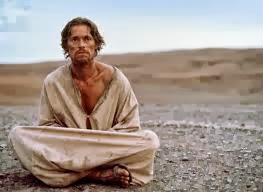
Anyhow, so: I de-plane, then flash-forward to my New York hotel room where I lie awaiting the sleep that I missed while flying. Flipping the 200 channels on my TV I stumble on one showing Scorsese’s 20-odd-year-old film of Kazantzakis’s The Last Temptation of Christ. Now there’s a movie that could only have been made by the respected firm of Scorsese/Schrader: an incredible treasure, of the sort they don’t make anymore (but, let’s face it, had to struggle very hard to make in the early-to-mid-1980s.) I don’t hesitate to award it the Capicola Cup for Personal Favourite Scorsese Movie.

Sceptics may think it resembles nothing so much as a troupe of Manhattan thespians, musicians and mime artists on tour in Morocco, shepherded by a director who’s only been allowed one day’s shooting with his beloved crane (but sure is making the most of it.) Still, I think anyone who lets themselves sink into the movie’s peculiar rhythm would have to admire it. For one thing, that rhythm is underwritten peerlessly by Peter Gabriel’s glorious score. But then just the performances, even. Willem Dafoe elegant and anguished as ever was (since when he’s often seemed to be acting in a foreign language.) Barbara Hershey, whose idea the whole thing was, exquisitely witchy as Mary Magdalene. Andre Gregory’s stark-eyed rail-thin John the Baptist, David Bowie unbelievably pitch-perfect as Pilate.

The picture reaches one form of climax in the Golgotha sequence, all stony, bloody desolation, Dafoe wearing the thorniest of crowns. But the best is all to come, the titular ‘Last Temptation’. As Paul Schrader put it, ‘The greatness of the book is its metaphorical leap into this imagined temptation; that’s what separates it from the Bible and makes it a commentary upon it.’

This is how I describe the film’s final half-hour in Ten Bad Dates With De Niro:
  “… abruptly the Nazarene finds the noise gone mute all around, and his gaze falls on a perfect little blonde girl [Juliette Caton] who beckons him down. Calling herself his ‘guardian angel’, she has golden curls, a full mouth and a Roman nose. She offers him the life of a normal man, assures him he has already suffered quite sufficiently for his Father’s purpose. She sits serenely outside the dwelling as Jesus and Mary Magdalene make love, blesses their marriage, and consoles him when Mary dies in childbirth. She watches over his patriarchal old age, and steers away from that troublemaker Paul (Harry Dean Stanton.) It’s only when Jesus is visited on his deathbed by a bitterly anguished Judas Iscariot (Harvey Keitel) that this ‘angel’ is called by her true name: for the last temptation is domesticity, and in short order Jesus is renouncing Satan and begging to be set back upon the upright…”
 That reminds me of what are probably the film’s two most powerful performances, even in the midst of that stunning array: flame-haired Keitel, passionately dour as a radical Judas, and Harry Dean Stanton, quite, quite phenomenal as Saul of Tarsus, he who became Paul. In the clip below Harry Dean is so good I almost want to pick up my mat and follow him.

Sunday, 24 October 2010

Costello/Springsteen: my kind of cabaret

Well, nobody told me this had happened, happily I found out for myself... But clearly Spectacle, the Costello show for Sundance Channel, is the sort of thing that should be on television all the time...

Wednesday, 20 October 2010

How the World Looks From Manhattan

I am in New York City this week, once more on the trail of Sean Penn and Paolo Sorrentino’s film This Must Be The Place. NYC is, as ever, a marvel, and just the same, only different... a world city, defining of America and yet not wholly American. My New York Times this morning was gratifyingly slim and manageable over breakfast, and full of interest, to wit:
1. Government expenditure: A big deal, naturally, Republican candidates for the Senate unanimously pitching from a platform that deplores ‘runaway federal spending’, but very shy (or else full of drivel) on the ‘What I Would Cut’ issue (other than taxes, the extension of the Bush-era cuts clearly dear to many GOPers.) I am relieved, in one way, to be off the scene as George Osborne displays his axe in the Commons today. And while resistant to any ideological formulation of the beauty of small government (and seconding Hopi Sen’s abhorrence of lectures on welfare dependence from trust fund babes) – as a freelancer I approve of Robert Peston’s tough-mindedness today on the public sector’s needful adjustment to how the rest of us manage our anxieties.
2. Democracy in Action: the standard of candidacy and debate in the contests for the US Senate seems shockingly poor, at least as far as the media is reporting it. In particular a woman called Christine O’Donnell, running for the GOP in Delaware, is setting the bar strikingly low. The ‘race’ for New York Governor is also descending into farce, judging by a Monday night hustings in which the minor candidates were given so much room to be minor that the main Cuomo-Paladino contest, vaguely defined already, got no clearer. Lest we get smug in the UK, I suppose the real lesson, for the millionth time, is that we surely get the politicians we deserve.
3. Ghost towns: A ‘new town’ in a district of the city of Ordos, China, is reported to be near-deserted, a product of boom times but waiting still to be populated by consumer-citizens. Having seen the high-end ‘ghost estates’ of Dublin recently, a vertical version of the empty luxury high-rises by Newcastle Quayside, I certainly feel the power of this metaphor.
4. China All Over: ... but economically China’s every move, micro or macro, is being scrutinised intensely, of course. Its announced raising of interest rates has a thumping feel to it, as does its widening embargo on mineral exports to the West. Reporting has a cagey feel to it. I must read The Economist this/next week...
5. That Hi-Tech Lynching, Redux: The 1980s beckon us once more... Supreme Court Justice Clarence Thomas’s wife, a Tea Party stalwart, is chasing Anita Hill again for an apology. Anita Hill is being very cool, in every sense, as the Times reports. (‘I thought it was certainly inappropriate...’ – Virginia Thomas’s request, that is...)
6. Gays in the US military: With Don’t Ask Don’t Tell seemingly erased, the TV news as well as print has had much of Dan Choi, an articulate young Asian-American previously discharged from the Army who yesterday, attended by umpteen reporters, sought readmission at the Army recruiting office just up the road from me at Times Square. Looks like he might have made it...
7. The decline of movie one-liners: The NYT arts section has it that Hollywood screenplays no longer offer widely quotable and cherishable dialogue in such profusion. But their ‘classic’ examples from Dirty Harry and Forrest Gump don’t have me lamenting in O tempora manner. Nor ‘Release the Kraken!’, from the remake of Clash of the Titans, parts of which I watched on the flight over, none of which seemed to me to surpass the pleasures of Ray Harryhausen’s hand-animated original.
8. Ryuichi Sakamoto: apparently the great man played a piano recital on Monday night, would I had been there. Though Steve Smith’s elegant review speaks of Sakamoto’s ‘curtains of white hair’ and ‘a decorousness better suited to a fern-throttled piano bar.’ But the audience apparently sighed with pleasure, as would I hearing the opening notes of the theme from The Sheltering Sky...

Wednesday, 13 October 2010

Cosmopolis: what a day that was

I've only just noticed that the Think Something Different site has posted up a pretty thorough record of proceedings at the Cosmopolis events at UEA campus on a blazing Saturday back in early June. There are transcripts, videos and photos of pretty much everything that went on. 'The Politics of Storytelling' session I did with Giles Foden and Oscar Guardiola Rivera is logged here, and the 'How To Pitch Your Film' dialogue with producer Judy Counihan is here. The transcripts are especially useful, as I would otherwise find my memory fighting a losing battle against all the beer I thirstily consumed (well, it was really hot...) at several pleasant hostelries during the conference period - one such joint being the reassuringly synthetic student bar close to where all the panellists had their lodgings, in clean-swept Novotel-like student digs.

Monday, 11 October 2010

NUFC: Half-Term Report 2010-2011

1. Seven points from seven... Would one have taken that back in mid-August? I suppose so, expecting wins over Stoke and Blackpool, a point at either Wolves or Everton, losses at Trafford and Eastlands and - pessimistic, like - home to Villa... So my radar’s about 50% askew.

2. Call the Blackpool result an off-day when none out of many chances got converted. But it was 2-2 with Stoke at SJP in 2008 when I knew we were going down. So one has to hope this season’s 1-2 will prove no more disastrous (i.e. merely depressing) than the 1-2 home losses to Sunderland in the reassuringly mediocre lower-than-midtable seasons of 1999-2000 and 2000-2001.

3. There we were thinking we had another French bobby-dazzler, younger and possibly with a better attitude than the last few, in Hatem Ben Arfa; and then that despicable Dutch Nigel from Millionaire’s Row near Moss Side goes and breaks the lad’s bliddy leg... My slightly one-eyed regard for the Orange, which even survived that last thuggish World Cup, has gone in the dustbin of history.

4. The Steve Harper injury had a cruelty to it and all. Tim Krul has been in our hearts ever since his UEFA Cup heroics of four years ago, but he’s being tested now, questions about his positioning here and there, though of course he’s not playing behind Cannavaro.

5. We’ve had some dastardly refereeing, and they’d better start giving us at least a few throw-ins, just to level it all out, y'knaa.

6. Andy Carroll - signed to 2015. He only wants to play for NUFC. May you stop at the top, bonny lad, by banging in enough savers for us this season.

(Illustration is the front cover of the latest issue of the mighty True Faith)

Friday, 8 October 2010

The taste of Labour

(Sighs...) I suppose now that the New Generation (TM) has truly got its feet under the desk, a tired hack like me needs to get a life, move on etc, from the dismal events of a fortnight ago. It's hard, though, to spit out the rancid taste of that spectacle, those grim cheerleaders for 'change', that result that could have been cooked up by some demoniac scientist in a laboratory, his intention to make everything about Labour look backward and third-rate and full of spleen... As someone who only came round to Blairism about 10 years too late I can't be regarded as a genuine tribalist or a reliable guide to 'the soul of Labour' (an expression you'd expect to see in any Gordon Brown peroration, and one I'd like to club to death with a baseball bat). Still, hard to bear, son...
My fellow college/student-paper alumnus Peter Hyman wrote in the Times the other day that "only victory at the next election will justify Ed Miliband's leadership bid." Even I - finding 'Death Ray Panda' hard to look at/listen to, and agreeing vehemently with Hyman's withering assessment on Newsnight last week - would say that's setting the bar too high. A Labour leadership candidate can't promise that sort of sway over the wider electorate, he can only hope to impress his congregation, work the ridiculous electoral college system, and so jump the hurdle in front of him - which for DRP was defeating his brother. And, you have to say, no prospective Labour leader can hope to ascend without having reached at least a hand-shake settlement with the trade union leadership, even though that settlement will, of course, be broken by said leader over time; and the failure of David Miliband and his footsoldiers even to get to the foot of the hill in this respect will always count as a serious demerit. For want of a nail...
A great political party doesn't die overnight, though the annals show it can slip into suspended animation or, if you like, aggravated nostalgia. For instance, my pre-Labour-leader-result prediction about the impending return of Neil Kinnock, the consummate Labour career-pol and parader of principles he would later junk in the hope of favour - proved grotesquely accurate, and gave David Cameron an easy joke for his Conference speech. As for the shadow cabinet, I would never seek to patronise Alan Johnson, but really, and nervously, I have to wish him the very best of luck for his new posting. In the words of their last elected PM, I will still be wishing Labour well, wanting them to win, since they are the future now... But I'm still reaching for the full-strength mouth-wash, looking for something to like about the new dispensation.
(Cartoon above by Steve Bell, of course.)

Monday, 4 October 2010

"Faber takes Doctor Forrest to Frankfurt"

That's the sort of headline a writer likes to see... The Bookseller's Charlotte Williams today reports the news that The Possessions of Doctor Forrest is one of the titles my publisher Faber is taking keenly to market at this week's Frankfurt Book Fair; and my editor Lee Brackstone is quoted handsomely in summary of the book's form and content. Yes, it's good to set the ball a-rolling...
The image herewith is of a sculpture in Vermont marble by the artist Philippe Faraut, entitled 'Yesterday' ((c) 2003) - nothing to do with Forrest save that its rather sinister allure is a quality with which I've tried to imbue this book - also, Forrest is certainly a tale in which face-masks and face-sculpting figure prominently...

Friday, 1 October 2010

Bookhugger column #7: Out of the woods...?

This month at Bookhugger I write about what I've mostly been doing this month as a writer (not to say last month, and several before that) - which is completing and revising the manuscript of my second novel, The Possessions of Doctor Forrest. Much, much more to come on that subject - possibly a whole other blog... As I say in the piece, Amazon now summarises the plot and reports the book "hitting stores" on May 19 2011.

Books about filmmaking: not tap-dancing about architecture

I just remembered... that over the summer I contributed to a Sight & Sound magazine poll that sought to determine what are the best-ever books published on the subject of cinema. Like all the other scribes consulted, I submitted my own personal Top 5 which was collated into an overall result, and you'll find my list among the 50 others here.

Friday, 24 September 2010

Credits are currency in this town...

'Big time, Bill! Big time, big time...!', as that old rock 'n' roll cove Ronnie Hawkins cried cheerfully (to Bill Graham, one assumes) near the start of The Last Waltz. Yes, I finally have my very own entry on the Internet Movie Database - the first, that is, under my current stage name, as 'Richard T. Kelly (Writer, "Coming Up: Eclipse (#8.6)" (2010))'. However, owing to past problems with consistency and consolidation, and the difficulty in finding the time to pursue these matters, it remains the case that I am also the IMDB's 'Richard Kelly (III) (Self, The Name of This Film Is Dogme95 (2000))' and also its 'Richard Kelly (VI) (Miscellaneous Crew, Lee Marvin: A Personal Portrait by John Boorman (1998)'. That's the problem with having a familiar name. Still, if the day should dawn that someone feels like typing up a Wikipedia entry on me (everybody else has got one), then they'll want to know this stuff...

A great hope fell, the ruin within, etc

I’m often left feeling sick around 4.50 on a Saturday afternoon, but that’s because I’m a Newcastle fan. Some might say I’m inured to losing, that losing, indeed, is my ‘comfort zone’, and accordingly that my being a David Miliband supporter fits firmly into that trend – since rumour has it the Labour leadership result is ‘certified’, and the polling/betting tendencies of recent days would strongly suggest that younger, shorter brother of his is home. Jesus wept. At least I can watch the football scores come in at ease... but then the Toon aren't playing Stoke until Sunday anyhow.
But somebody please do wake me up whenever this curious Ed Miliband character has demonstrated an iota of worth. I will have to avoid the airwaves tomorrow, as I strongly anticipate a number of interviews with a euphoric Neil Kinnock… Still, as before, at least I’ll have to find something else ‘political’ to blog about now. Wonder what’s happened to that Purnell fella…? Has Alan Milburn started attending cabinet meetings…? Maybe I need to make a fresh assessment of what’s-his-face Clegg…

Monday, 20 September 2010

The Friends of David M

A shout out/back to Mark Nottingham, Labour councillor and blogger, who seems to have enjoyed the sport of my previous post on teenage pop-rock nostalgia, and has just kindly commended this blog of mine to his own readers on the additional grounds of my being agreeably mad for both the Toon and for David Miliband - two noble causes, I'd say, the epousal of which, sadly, seems to bring more sorrow than joy... Still, I do give thanks that this Labour leadership contest is nearly done, for without doubt I need to find something else to obsess/blog about...

Saturday, 18 September 2010

15 albums when I was 15...

Currently doing the rounds on Facebook again is one of those pop-cultural chain-letters wherein a friend offers a list of 15 albums that have meant something to them, this list copied to 15 friends and appended with the request that each friend make their own selection of 15 LPs and copy this on to 15 more... Impossible for me to play this game by the stated rules - what, only 15? - but I thought I could put some useful parameters round the exercise and give myself a little Proustian rush by picking 15 albums that had influenced me considerably by the time of my 15th birthday in late 1985... List as follows, roughly in order of when I first heard/bought/taped off a friend the long-player in question.

Blondie, 'Parallel Lines'


The Beatles, 'Revolver'


Talking Heads, 'Remain in Light'


Elvis Costello, 'Imperial Bedroom'


Kraftwerk, 'The Man-Machine'


Dexy’s Midnight Runners, 'Searching for the Young Soul Rebels'


Peter Gabriel, 'Peter Gabriel (IV)'


Echo and the Bunnymen, 'Porcupine'


Bob Dylan, 'Infidels'


Bruce Springsteen, 'Darkness on the Edge of Town'


Frankie Goes to Hollywood, 'Welcome to the Pleasuredome'


Run DMC, 'King of Rock'


New Order, 'Low-Life'


Propaganda, 'A Secret Wish'


Kate Bush, 'Hounds of Love'

Monday, 13 September 2010

Good old common sense in the FT

Because I agree with him, I must say that Phillip Stephens talks customary good sense in the FT on the already wracked state of the ConDemNation, and the resultant opportunity for Labour:
ConDemNation: "Britain’s coalition government set out its plans to eliminate the fiscal deficit in the bright sunlight of certain conviction. A couple of months later, it confronts the chilling realities of shrinking the state...Nick Clegg protested the other day that the spending cuts drawn up in Whitehall were “not dramatically different” to plans laid by the previous government. This softening in the language of austerity says it all. The Liberal Democrat leader once thought “savage” reductions were vital to repair the nation’s finances. Now he must weigh the political costs..."
Labour: "David [Miliband] is the choice of those at the top of the party, who are keen to return to power. Alone, he has talked about rebuilding the coalition that won the party three election victories from 1997. His handicap is that this tags him as the Blairite choice... Ed, the younger Miliband, who could yet win as everybody’s second choice, has offered mostly mush – policies and promises calculated to make the party feel good about itself and about his candidacy... By choosing David Miliband, Labour would be saying it wanted to win back England’s aspirant classes – that it was still serious about power. But the party’s heart could yet rule its head. Mr Clegg – and Mr Cameron – are cheering on the younger of the two brothers."

Monday, 6 September 2010

Bookhugger column #6: Novelists talking on telly

My Bookhugger column last month (last week, frankly) was inspired by the wonderful BBC4 archive series In Their Own Words, culled from the Corporation's back-catalogue of interviews with major British 20th-century novelists. Television does indeed compel us to look at books, so long as the programme-making and writing in question have sufficient spark. It took a while for TV to 'do' book-chat without too many excruciating pauses, but P.G.Wodehouse, here c. mid-1950s, biting amiably but hard on the end of every query, shows himself to be ahead of his time, whatever the culture once thought.

What We Did on Our (Bank) Holiday

This picture just in courtesy of my brother, who was one of our party of nine (inc. 4 kiddies) sharing a big old family-cottage-rental up in Suffolk last weekend. Behind us here is the 16th-century Melford Hall, as impressive up close as it likely seems even in miniature, the lawns of which were as lush and springy as any I've ever laid foot on.

Dublin's the Place...

Tony Blair and I both were in Dublin on business at the tail of last week, but I should say that our paths never crossed; nor did I have to face eggs and shoes thrown at me in public, unlike the ex-PM and memoirist. While over there I did overhear some Irish Robespierre-type interviewed on the radio news, bullishly making known his intention to protest Blair's presence on local soil, based on this pilgrim's own belief that war criminals, liars and scoundrels have no place, no prayer and no mission in Ireland.
With all due respect to (and personal fond regard for) Eire, the Irish, and the proper instinct to fight against evil, I’m not sure I’d have wanted to make so rash a claim as this chap, not in the full and harsh light of Irish history. To take only one instance: in Dublin’s Fairview Park, close to where I was lodging, I happened to pass this civic statue (pictured) of Sean Russell, the former IRA quartermaster who opened up the organisation’s contacts with Nazi Germany in the late 1930s, out of what looks to be ‘physical force’ ideological idiocy (exploiting ‘England’s difficulty’ and all that) rather than any active enthusiasm for the jackboot. Still, the fight against imperialism seems often to entail that one must make a lesser-evil choice between empires. I know that self-styled Trots plus some of the broader church of Not-in-my-Namers think themselves the true-blood scourges of all known and existing nastiness, i.e. for all the Good against all the Bad, be it Right or be it Left – but it’s only their fundamental estrangement from reality and its pains that enables the taking of such high/mighty positions.
My actual business in Dublin concerned current plans for a second and revised edition of my Sean Penn: His Life and Times, first/last published in 2004-05. Since Mr Penn has been around the Liffey shooting a section of his work on Paolo Sorrentino’s new film This Must Be The Place, I was very fortunately able to grab a little time with him on- and off-set to talk over his recent endeavours and roll some tape toward the updating of the book. As for This Must Be The Place, it’s a very exciting prospect – would have been so just on paper for the teaming of Penn with the maestro writer-director of Il Divo. But the bits and pieces of filming I witnessed encouraged me to believe this will be cinema that is highly original, unclassifiable and very, very special.

Thursday, 26 August 2010

Labour's choice, final strait, horses for courses...

The New Statesman was, I think, first out last night with the very welcome news that Jon Cruddas is endorsing David Miliband for Labour leader. Apparently Cruddas was very taken with DM's Keir Hardie Lecture a few weeks back (also noted here.) "What was interesting to me about this", Cruddas comments, "was when he started talking about belonging and neighbourliness and community, more communitarian politics, which is where I think Labour has to go." Hear, hear.
The Staggers itself has come out for Ed Mili today, declaring that he is somebody they feel could, conceivably, become a "bold, charismatic, compassionate and visionary" leader. I'm still left wondering which meeting I missed where the younger/shorter Miliband brother offered such powerful evidence of these inchoate qualities. John Rentoul today describes the sanctimony, the small-meeting-room populism and evidently mounting peevishness that many of us associate more readily with Miliband Junior.
The NS is careful to make a secondary case for David Miliband, however heavily they count against him what they call "his mistaken support for the catastrophic invasion of Iraq." But they see him as the darling of "the right-of-centre commentariat" whereas their man Ed is the "change candidate"; and so they hope that DM, if defeated, will remain in politics as "his brother's lieutenant-in-chief." This would require extraordinary stoicism on David Miliband's part, if it turns out that what his brother is selling really is what most Labour voters want... and I only hope we aren't forced to witness such a fraternal job offer being made in the first place, much less the ghastly spectacle of its acceptance. The differences between these candidates are clear now, and only one, it seems to me, would not be utterly wasted in a backseat capacity.

Sunday, 22 August 2010

NUFC 6 Villa 0: Bad Karma

There are bitter and intractable and perfectly understandable enmities between football teams and rival fans thereof, usually based on geographical proximity, or else some historical grudge from out of the annals. And all this is good sport. I don’t know who Aston Villa – a club I’ve tended to admire on all sorts of levels – normally have their beef with, because I don’t know much about the midlands, but I’m sure it’s not with Newcastle United. So I was perplexed and irked when a significant section of Villa’s home support came to their last game of 2008-09 seemingly with the chief intent of barracking NUFC and generally celebrating our relegation to Division 2. That NUFC has very often made itself a laughing stock in the last 10 years is beyond argument: it must be why sportswriters like Simon Barnes or David Lacey still feel so comfortable wishing the club ill and broadcasting their anti-Geordie schadenfreude. But still, what kind of no-mark must you be to sit at home like some piddling schoolboy, inking out a bed-sheet banner so as to jeer a visiting team off on its way to the lower league? Who’s Your Next Messiah? Ant and Dec? That was one, wasn’t it? ‘Messiah’ is a term that those geniuses on Sky like to think Geordies are obsessed by. NUFC fans aren’t generally interested, though we do really, really like the loyalty shown to the club by certain favoured sons and local heroes, as does any club that can boast such an array.
So to today’s Toon-Villa rematch at SJP, and I was struck by some Villa texter to the BBC with his side already 3-0 down: "This isn't over - Newcastle can't defend. If we can stop them scoring it could finish 4-3! Up the Villa!..." Ah, another mad-for-it Villan feasting on ‘Premiership’ legend, courtesy of Sky. There certainly were more goals in the game, except it turned out to be the Villa that ‘couldn’t defend’, and Bensham’s Andy Carroll who filled his boots. Now, he’s not the Messiah, mind. In fact he’s often a naughty boy...
But to the bigger picture: as usual it’s clear from the off that the Barclays/Sky Division 1 contains leagues within leagues, and Newcastle are emphatically not in the top flight: the only realistic goal remains survival. I’m not sure which league Villa reckon they’re in, but I daresay they're giving the subject a mite more consideration than they'd expected to as of tonight.

Saturday, 21 August 2010

Clegg: Dear me how...

Hopi Sen deserves credit for making more widely known this cringe-inducing report by the excellent Paraic O'Brien of BBC London News, wherein the so-called Deputy Prime Minister finds himself hoist by his own New Politics petard:

Thursday, 19 August 2010

Hitchens unbowed, never being boring


The other night I watched an interview posted online at the Charlie Rose talk-show website, wherein the masterful conversationalist Rose (we have no-one quite like him in this country, strangely) talks to Christopher Hitchens partly about his recent memoir but mainly about his recently diagnosed cancer of the oesophagus, for which he’s receiving chemotherapy, looking as drained by the ordeal as one would expect, but remaining as thoughtful, articulate and incisive as ever was. He's reading the letters of Saul Bellow, who once wrote that awareness of death is the dark backing a mirror needs in order that it truly reflect.
The interview is full of good meat, but I think many will find special interest, given Hitchens’ history of invective against phoney, cowardly, sinister and corrupt politicians, in his response to the question of which political figures, if any, he has admired. I daresay if Rosa Luxemburg had ever attained democratically-elected office he’d have talked about her, but in any case his pick was Tony Blair. The moment comes at 37:14 in the link above.
I remember once hearing Blair as PM, circa 2006, getting one of those famous ‘grillings’ from John Humphrys on the Today programme, and thinking to myself, ‘Christ, you need to pack this in...’ But Mr Humphrys is still in that job, and indeed several others, giving out in the amusedly irritable manner for which, clearly, he’s loved by many. It seems that Humphrys also writes a weekly-or-so column for YouGov on a big issue of the moment, and the other day it was Tony Blair’s donation to the British Legion. Weirdly Humphrys seems as keen as others in the BBC to quote in seriousness the risible views of those clapped-out old SWPers who believed that public opposition to the ousting of Saddam Hussein was the mass-radical 'anti-imperial' moment they'd waited all their lives for. The trope of these columns, which YouGov presumably asked for, is to conclude with a long list of opinion-poll style questions. These are those asked in respect of Blair:
“Do you think Mr Blair’s gesture is a genuinely selfless gift or do you think it is self-serving? Do you think the reputation he has gained since leaving office for being too interested in money is fair or not? Do you think he should feel guilty or not about the money he has made? Should he feel guilty or not about his decision to invade Iraq? Did he deceive the country or not? Do you think he has a criminal charge to answer or not? What do you make of the ‘blood money’ charge? Should the case of David Kelly’s death be reopened? And will you be buying Tony Blair’s memoirs?”
For what it’s worth, my answers are: Nothing in life is selfless, but it is a huge gift, likely given for complex motives, the merits of it obvious; He’s as interested in making money as the rest of us; As before; No feeling human escapes remorse over any part in the loss of innocent life; Blair clearly believed, like David Kelly, that some WMD capacity remained; No, can't see it; Bereaved parents of servicemen and women are, very obviously and profoundly, more than entitled to this opinion, though some hold it more impressively than others; No, still looks like suicide to me; and Yes, unless it's bought for me.

Wednesday, 18 August 2010

Channel 4 'Coming Up' 2010: Now Showing

This year’s Channel 4 series of 30-minute 'Coming Up' films started its broadcast run as of last Thursday, and Eclipse, from a script of mine originally entitled Jennifer, shows next week in a double-bill with Dip, written by the fine novelist and travel writer Simon Lewis.
Back in April I saw all seven films in the current series projected together in a London cinema. The same crew worked all seven four-day shoots back to back, a truly staunch achievement. Myself, I feel lucky to have been involved in what is one of the precious few windows for new starts in television, and to have rubbed shoulders with such a talented group of young people, not least since I’m long in the tooth myself to be part of any kind of New Voices scheme...
At that London screening Michael Lennox, who directed Eclipse, mentioned that it wasn’t the sort of script he would ordinarily do. Nor was it the sort of script I’d normally write. I think both of us in our own ways have tended thus far to ‘do’ realism, whereas Jennifer/Eclipse was intended unabashedly as a fable based on an outright impossibility.
The project was a highly novel challenge-opportunity, really, in that Michael and I were paired for work before a script was in place. The scenario I initially submitted, entitled The Home Secretary (probably self-explanatory...), ended up looking too dramatically and logistically cumbersome for the half-hour slot. So I quickly wrote up three alternative scenarios, and Jennifer, as it was then, was the one Michael plumped for. The other two were more down-at-heel/'real' in milieu and subject, but then it seemed a solid choice to try out something about sexuality, attraction, physical allurement, albeit rather dark in tone and outcome.
I saw only a little of the shoot, but when I did briefly meet members of cast and crew they all seemed to think the script was ‘autobiographical.’ Perhaps that’s what they’d been told – or else they reckon that’s mostly what writers do. In truth, I’ve never written anything autobiographical: my life’s been too uneventful, I’d get embarrassed. What I tend to do is write around things I’ve observed or researched, sometimes under the influence of an existing dramatic structure or genre or leitmotiv that I’ve admired. And in that built scenario, from inside other people’s skins, I’m free to imagine how that might feel.
Jennifer was drawn from a few things I’ve noticed - one being a trait in certain people who do very taxing and specialist jobs to sometimes remove themselves from the sphere of romantic relationships, and to set the bar for admission to same rather distantly high. Another was a memory I had of sitting in a social situation with a mixed group of friends, and watching one young woman decide to liven up proceedings by doing do a sort of mock lap-dance in the face of one of the guys. It was a lark, the girl was lampooning the crassness, the tackiness of that sexploitation, she was ‘being ironic’ – except she wasn’t, since she was also making a display of her own physical self-assurance. And it seemed to me the real irony was that her whole performance felt about as attractive as a runny nose. Of course, different strokes for different folks... That’s why the film model I decided to refer to in Jennifer, with maximum lack of originality, is Hitchcock’s legendary and endlessly-referenced Vertigo.
The critic Danny Peary once wrote of that movie: ‘Hitchcock states that, given a choice of women, men are so weak they’ll always pick the helpless over the independent, the attractive over the plain, the frigid over the accessible, and the illusionary over the real...’ There’s an odd one out in that sequence, of course – only Hitchcock would actively pick 'frigidity'. And whatever their preferences, people are shown by psychology to generally pair off at 'appropriate' mutual levels of sexual attractiveness/plainness. But if we accept that much, with Jennifer I wanted to take the Vertigo doppelganger schema but reverse the usual polarity – the acme of feminine appeal then being dark, reticent, ‘independent’, intelligent - rather than blonde, extrovert, grasping, shallow.
The finished film is, I sensed, a little more ambiguous. There was a lot of discussion and work on the script, under the aegis of the experienced producer Elinor Day (who actually came up with the revised title Eclipse.) Michael Lennox definitely brought his own interpretation to the piece by way of certain directorial nuances. That’s film for you: a collaboration, a fusing of sensibilities. On the subjects of love, sex, attraction, we surely do all of us have a set of opinions that are internal and personal. You do, too, right? Anyhow, if you tune into Eclipse next week then I hope you find something worth a look, or a gaze, as the 'theorists' used to say...

Tuesday, 17 August 2010

Dr Jekyll Rises Again

Ian Rankin, a celebrated and most perspicacious admirer of R.L. Stevenson's Dr Jekyll and Mr Hyde, has now written a foreword to a re-issue of the text, extracted in the Guardian. Jekyll/Hyde enthusiasts will find much to celebrate in Rankin's piece - in particular, perhaps, his stress on the story's 'complex narrative', which is much more tricksy than the umpteen film versions that doggedly take Jekyll's point of view from inside his laboratory as he struggles to perfect his 'transcendental medicine'. Whereas in Stevenson, as Rankin points out, "Jekyll himself figures only as a friend of the other characters and narrators – right up until the revelation provided by his "confession". We start the book in the company of two gentlemen called Utterson and Enfield..."
Can readers who encountered the films before the original take the same pleasure, the proper pleasure, in the story's unfolding? "Sadly," Rankin writes, "we'll never know the thrill experienced by this explosive book's original audience. Dr Jekyll and Mr Hyde is a work of suspense, but we all know the twist these days, don't we?" All I can say is that while still a schoolboy I'd seen about a zillion adaptations of Jekyll without having savoured the ur-text, but only once I had Stevenson did everything become clear, gloriously so. The best film of Stevenson is actually the Stephen Frears/Christopher Hampton version of Valerie Martin's hommage/rewrite Mary Reilly, but it was a picture that thrill-seeking audiences didn't warm up to. It looks better every year, but - like its inspiration.

Colm Toibin: Among the Flutterers

Colm Toibin writes splendidly about the sexual problems of the Catholic Church in the current London Review of Books. With a wry, wise touch he addresses the Church's sorry efforts to assert its own 'victimhood', notes its (much needed) loss of authority in Eire ("The bishops, priests and nuns are sinking, but have every intention of putting up a struggle before they drown"), and is interestingly sceptical about conservative Catholics who believe their Church was only corrupted quite recently by a kind of homosexual entry-ism.

On a personal level (at 16 Toibin too thought he had 'felt the call') he writes with the expected candour and precision: "Becoming a priest solved not only the outward problem of forbidden and unmentionable sexual urges, but, perhaps more important, offered a solution to the problem of having a shameful identity that lurked in the deepest recesses of the self." (The solution Toibin has in mind, by the way, is a quiet life of compassion, "doing good and being good", not seizing the chance to live in an all-male cloister and prey sexually on the innocent and powerless.)

There is humour too, as he mentions a writer friend who visited an Irish seminary in the 1980s, and looked on as a fair few "young candidates for the priesthood, boys from rural Ireland, attempted Wildean witticisms; he noticed them wearing specially tailored soutanes, moving around each other, excitedly, like a flock of girls..." This is Father Ted territory. Toibin also has some sport with the suspicions that seem to attend Pope Ratzinger's desire to carry on like an elderly fashion victim and keep a handsome valet at his side. But I wouldn't know anything about that... Nor do I understand what Toibin's trying to admire, like so many before him, in the enigmatic fence-sitting John Paul II.

By the end, though, Toibin has put the Church's sex problem back into succinct and troubling form: "The problem is that, after all that has been revealed, many of us who were brought up in the Church now know that we once listened to sermons about how to conduct our lives from men who were child molesters. And that senior members of the Church hierarchy protected these men, believing that the reputation of the Church was more important than the safety of children, and that Church law was superior to civil law. When they were found out, their sorrow was not fully credible."

Friday, 13 August 2010

40 years, 400-odd goals

Per the previous post: someone who’s made the best of their allotted time to date is Gosforth's Alan Shearer, 40 today, and most likely treating himself to a few holes of golf somewhere nice. Hard to imagine a second career sat on a sofa with Alan Hansen will ever quicken his pulse in the same way as banging them in before that sea of black-and-white. Of course, one no longer stares at the NUFC fixture list with the nagging hope that Al could yet be persuaded to get his boots on... But still, Old Trafford, this coming Monday night... I certainly hope somebody in stripes has plans to step up...

40? Forget it, Jake...

For the last 12 months me and my peer group/tiny circle of friends have been staring down the barrels of our 40th birthdays. One associate of mine actually said to me that, in his opinion, in this day and age, it’s really 50 that bears the gravity 40 only used to... We work longer, see, have our kids later, carry on carousing and playing with toys way past our teens and twenties, 40 just isn’t the staging post it used to be, three score years and ten is ancient history and all that…
Well, it’s a theory. But for each one of us the hour-glass is set up nonetheless, the sand doth run... I suggested to my friend, and he agreed, that the big birthdays are really an existential matter – one’s subjective inner sense of how far one has travelled to date, what one has achieved, what one feels oneself yet capable of – also, to some inevitable extent, certain significant other people’s estimations of the same, which may, frankly, determine how many more chances you get…
One inspiration for me is found late on in Roman Polanski’s memoir, where he describes his cautious, critical response to a script sent him in 1973 by Paramount’s Robert Evans, a script he liked but felt ‘simply couldn’t have been filmed as it stood.’ Polanski was sorry not to be more enthusiastic but his morale was low, after personal tragedy and a couple of pictures that hadn’t worked. Moreover, he writes, ‘I was also about to turn forty – a depressing moment in any man’s life.’ But he persevered with the script, took the meetings, resolved to do the movie. It was Chinatown, and it turned out, gosh, rather well. Indeed movies don’t come a great deal better. I guess the morals are, keep your nose to the grindstone, and don't be afeared to do something different.

Thursday, 5 August 2010

'A kid from New Jersey, wrestler...'

Y'know, I once sat in a booth at Trader Vic’s in Hollywood with Tom Cruise and Claudia Schiffer, inter alia. I hadn’t invited them to join me, it was my booth, I was just sitting there drinking Wild Turkey and I suppose I could have told them to sling it. Instead, it was me who crept away, left the great ones to their symposium... What I did notice – it was Awards Night next door, and Cruise had been nominated but came out empty-handed – was how exceptionally, avidly pleasant and enthused Cruise was being to everybody, especially winners; but then so companionable was the mood he made that maybe even a schlump like me could have stuck around longer…
On today’s Guardian my friend Ryan Gilbey writes about the inevitable usurpation of Cruise by Leonardo DiCaprio as Hollywood’s biggest male star. If you get to #1 the one thing you know for sure is you won’t always be there, but Cruise had an amazing run. DiCaprio is a brilliant actor and deserves every success. Cruise has done some good work in some good movies, but there are some notable offences in the oeuvre and the persona to consider also. What has to be respected is his work ethic. Ryan quotes adeptly from Sean Penn: His Life and Times, Sean talking about his work with Cruise on Taps when both were barely out of their teens:
"This was a guy who was ready for his chance, no question about it. He wouldn't have known that himself – he was second-guessing everything all the time. But that didn't stop him from committing when it was time. Cruise was so . . . like he was training for the fucken Olympics. I think he was the first person I ever said 'Calm down!' to..."

YouGov rates Labour: as you were, then

Richard Darlington clearly has an important role at Demos but I don’t know whom he thinks he’s admonishing with this piece at Labour Uncut, wherein he laments a YouGov poll suggesting Labour is now thought ‘‘weak’ (73%), rather than strong (16%) and ‘divided’ (72%), rather than united (19%)’, also ‘out of touch’ and representing ‘‘the past’ rather than the future.’ That’s just what happens when you lose after 13 years in power, your beaten leader resigns, and you slouch over to Opposition benches, usurped by both larger parties that formerly sat there. No Labour leader could reverse these shallow, obvious perceptions right now, even if he or she were indubitably the one to lead the party to the new policy dawn Darlington rightly hopes is coming, but only after what will first have to be a long, slow dusk. Frankly, as an admonition I prefer the simple formulation of the Sun's "disenchanted Labour voter" cab-driver Grant Davis (46): "Whoever wins is going to have a massive job on their hands making Labour electable again." Grant is for Andy Burnham, as it happens, but that's a reasonable position to hold, if not my own, as you know...

Friday, 30 July 2010

Bookhugger column #5: Townshend, Faber, Electric Eden

For my Bookhugger column this month I was resolved already to write on Rob Young's splendid Electric Eden (of which you will surely read more elsewhere this month, the excellent blog-site in support of which is here.) But since music and its celebration in writing was the matter, and since Faber and Faber have serious form in this area, I thought I'd broaden the piece so as to say a little of the part in the story played by Pete Townshend, Faber's second-most-famous editor in the firm's history after Thomas Stearns Eliot. Townshend is also appropriate to any discussion of English music specifically, or of music as a higher (or lower, Chthonic) power, and such is the terrain of Rob Young's book.
Anyhow, in writing up the piece I discovered on YouTube the 1985 South Bank Show on Townshend, and just wished to share with you a) the sheer genius of opening the show on an extreme close-up of Pete's vibrating strings as they are struck, and b) the commensurate genius of letting the emergent tune, Pete's 'Give Blood', run on over the opening credits as a replacement theme to the episode.

Tuesday, 20 July 2010

Sean Penn's efforts in Haiti

Since I'm Sean Penn's official biographer - a designation that never fails to generate surprise, amusement and/or bafflement in any social gathering to which it comes as news - I am rarely to be found in neutral mode when it comes to assessments of the worth of what Penn does with his time in this world. But I trust I'm not alone in thinking Sean's efforts for the cause of earthquake relief in Haiti are hugely honourable and commendable. This recent report by Guy Adams of the Independent deserves to be more widely known. The photo of Sean putting his back into it is (c) Getty,