Saturday, 13 August 2016

The Knives reviewed in the Financial Times: 'Thrilling in the truest sense.'

Dan Mitchell's art for the FT review of The Knives
This weekend's Financial Times brought a great boon: a very gratifying review of The Knives by the critic and author Erica Wagner, who clearly read the book as closely as any novelist could hope for and was also kind enough to name-check my earlier novel Crusaders (2008).

The FT also allotted a generous space and positioning to Wagner's piece and illustrated it with a drawing by Dan Mitchell that very adroitly projects the menace suggested in the titling of the review: Ministry of Fear.

Some choice extracts:

'The current political climate, with reality giving fiction a run for its money, is one in which the jaded reader might be hard to impress. Which makes Richard T Kelly’s The Knives all the more admirable... This is a sharp and engaging tale...Kelly makes lives the reader can believe in. Novels are thrilling in the truest sense when they feel as if they are built of flesh and blood; it’s Kelly’s success in doing so that makes his final twist of the knife even more shocking.'

Friday, 12 August 2016

The Knives: a Prospect podcast with Sameer Rahim

Follow this link for the audio of a 20-minute conversation I had last week at the London offices of Prospect magazine with their Arts & Books editor Sameer Rahim. For me it was very engrossing. 

Sameer's Twitter avatar is a picture of Joseph Conrad, which would be a fine thing to do at any time; but if you should cross his path at any point then the tale of why he chose Conrad at this particular moment is well worth the telling.

This is the billing on the Prospect site:

In Prospect’s latest podcast, the novelist Richard T. Kelly discusses a Conservative Home Secretary struggling to cope with a multitude of problems: terrorism, civil liberties, immigration and human rights. But Kelly isn’t talking about the former Home Secretary Theresa May; he’s talking about David Blaylock, the protagonist of his new political thriller The Knives. Through Blaylock, Kelly explores the difficulties of being a politician in the 21st century: the knives are out for you, always.

Thursday, 11 August 2016

The Knives makes The Evening Standard's Londoner's Diary: 'A big year in politics'

The Evening Standard has been a fixture of the intra-London commute for so long now that I can remember it before it was distributed for free. Around town you can certainly feel the presence of the 900,000 or so copies that go out these days. So it was a thrill to see The Knives covered yesterday in the Diary pages, a space usually reserved for Great & Good: aristocrats, moguls, beloved entertainers, and senior politicians. It's on the back of the last category, I guess, that me and my novel rode in. My thanks to Robbie Griffiths of the ES for picking up on the story.


Wednesday, 10 August 2016

Esquire reviews The Knives: 'A finely honed slice of modern political drama'

I'm delighted that the September issue of Esquire now on stands finds room in its cultural highlights section for a write-up on The Knives. One thing that's always lively, surprising and educational about reading reviews of your own stuff (and in a good way, I mean) is seeing how the reviewer selects from and synopsises the book's narrative. Very deftly done in this case, and with no little wit.

This is the critical conclusion the review comes to, which is very gratifying:

'What Kelly... has done so well is to craft an exciting novel set in the political arena... it grips from the off. This book could not also be more timely, with the threat to MPs' personal safety and radicalisation on British soil as alive on these pages as they are in tomorrow's headlines.'

Monday, 8 August 2016

Nick Cohen on The Knives (Observer): 'The best novel about modern politics I have read in years'.

The shrewdest observation I've ever heard said about reviews comes, if I remember right, from Roman Polanski, to the effect that if you decide to believe whatever good write-ups you're lucky enough to get then you have to believe the non-good ones, too, since there's no substantive difference that anyone can point to.

And fair play to that, but obviously one's attention tends in certain directions and not others. Nick Cohen, political writer for the Observer and the Spectator and Standpoint, author of (inter alia) What's Left? and You Can't Read The Book, reviewed The Knives for last Sunday's Observer, and I couldn't have wished for more in appreciation of the novel - in particular his assertion that it is 'the best novel about modern politics I have read in years.'

The Knives launched at Daunts Cheapside 04.08.2016

My kind of shopfront
The independent Daunts chain of bookshops is a huge boon to London and its readers and writers. If we don't have as many booksellers as we might wish in London (compared, say, to coffeehouses, where the product is hardly cheaper though its use-value is cursory), then these ones that we have are to be prized.

The City is a zone of London where the habitues could always do with some edifying reading to keep their eyes above the horizon, and that's what Daunts Cheapside offers. Like every iteration of Daunts I've seen, it's well-stocked and adroitly-staffed and all about good books.

Editor Lee Brackstone addresses the room
That's where Faber & Faber and I went to launch The Knives last Thursday night, the night of the day of the novel's publication. It was a lovely crowd, on a heady August evening when people not already off on their holidays could have been excused for choosing the pub instead. The pub, in any case, is where we ended up, but not before the speeches and toasts that are customary to wetting a book's head.

Edna O'Brien dispenses the wisdom
Obviously when you write for a living you have writerly friends, but I would hope to be forgiven for singling out the attendance of one author to whom the rest of us are naturally inclined to bend the knee in this day and age. Edna O'Brien's literary production has been enjoying a tremendous resurgence at Faber and Faber where she, like me and a good few other fortunate souls, draws on the editorial support of Lee Brackstone. So I was delighted when Edna dropped into my do, as indeed was everybody else in the room.

Tuesday, 2 August 2016

A few things about The Knives


1. My novel The Knives is published this Thursday, August 4. I first began thinking about its subject in late 2009, and wrote a fledgling version as a prospective short-form Channel 4 drama. My interest had been stirred by some of the very public political/moral dilemmas facing the then-Labour Home Secretary Alan Johnson. That interest deepened when I read David Blunkett’s lengthy and detailed published diaries. I wondered what it would mean to discharge such duties - to walk a mile in those shoes, imaginatively.

2. I began to plot out a long-form story about a flawed man doing a legendarily difficult job, mired in crises both professional and personal – a Home Secretary with no home of his own. Since governments come and go, and since a writer's job is to make things tough for one's characters, I soon knew that my protagonist had to be a working class Conservative, in a north of England constituency, who had served in the army. By 2010 I had a title for the piece, Homeland, but I was just too slow out of the blocks on that score.

3. Research proper on the novel, both from written sources and by going to people and places directly, went on from 2011 right up to 2015. In real life, and for all that the job is considered a poisoned chalice or gilded coffin, Theresa May endured as Home Secretary throughout those years – right up to her recent promotion. Her discharging of duties at Marsham Street was of obvious interest to me, as it has been to journalists on the Westminster beat, and never more so than now. (Andrew Rawnsley’s piece on May and her circle of advisors in last week’s Observer is a very good and insightful place for newcomers to start.)
                                                                                                                    
4. The Knives, though, is fiction. It’s not based or modelled on anyone, it’s no roman a clef. It does, though, aspire through a story to offer some plausible dramatic scenarios and imaginative truths about arguably the hardest office in politics - and its complex relation to this nation of ours and her citizenry.

5. The novel is dubbed a ‘political thriller’, essentially for shorthand purposes. I would see it as a drama that’s intended to grip: a Scandinavian boxset of a novel, if you like, with multiple concurrent plotlines and themes. I would be really pleased if admirers of the TV series Borgen found it of interest. Like my first novel Crusaders, The Knives tries to address some national themes of public interest, in a dramatic manner. Like Crusaders, it’s in the last act that the thriller elements coalesce - the clock begins to tick for the central character, and the train drives down one track to the denouement.

6. I guess there’s a certain timeliness in a novel about a Tory Home Secretary who's widely fancied to become Prime Minister appearing at this moment – amid a year of politics that has been more interesting than many of us would have liked. The book perhaps foreshadows a few things that have become reality. In at least one regard I wish they hadn’t.

7. In a time of political tumult and crisis, like this one in which we’re currently enveloped, people who read a lot can be forgiven for losing their heads in angst and dread; and fiction has a hard fight to show it’s more useful for what ails us than Twitter. But it’s a worthwhile fight, nonetheless. Of course there is a living to be had from arguing that whatever’s happening today is the definitive episode in human history. But it isn’t. Ecclesiastes got that dead right.

8. The EU referendum result defenestrated a Prime Minister and cleared out more than one of his self-styled successors. The ambitions of Cameron, Johnson and Gove, and the popular failure of the case for Britain to remain in the EU, have been shut down, shuttered and bolted: the narrative of those events has already been well told in journalism, and no doubt there will be a non-fiction book or two to follow.

9. Still, our oft-maligned political system managed to propel the most capable candidate into Cameron’s place, once the blatant hoodwinkers had fallen away. The aftermath of that referendum vote, however, will be long and painful, and will define the premiership of Theresa May. The problems that faced her as Home Secretary over six years – inter alia, levels of immigration, varieties of alienation in England’s regions, forms of English nationalism, concern for England’s identity and the threat of 'domestic extremism' in various forms – have, I think, a fair bit to do with why England voted as it did on June 23. The Knives is certainly much preoccupied with such matters. My fictional Home Secretary David Blaylock has his (invented) Westminster constituency on Teesside, where all areas voted to leave the EU by over 60%.

10. In terms of government, such deep-rooted and persistent problems appear to be the burden of the Conservative Party, since Labour has, for the time being, abandoned the business of real politics. And the troubles are not going away – we will reckon with them for years to come. Fiction, I believe, has a part to play in the reckoning, and I wrote a piece for the Guardian last week on how novelists have borne witness to politics down the years – as ‘unacknowledged legislators’, if you like - certainly as watchmen, interpreters and dramatists of our predicaments.

Friday, 29 July 2016

'The Knives' is nigh


Five or so years in the making, my third novel is finally out next Thursday. I'm due to have a piece in tomorrow's Guardian Review about politics and fiction, and after that we will see what kind of coverage may come.... 
 
In the meantime this pre-publication response to the novel from Alastair Campbell is one I wear with pride:
 
'A gripping read from start to finish. A rich, multi-layered account of the complexities of modern government where personal, political and cultural realities mean simple choices are hard to come by.'

For sure I will be at the Edinburgh Book Festival on August 17 for an event with Mark Lawson chaired by none other than Val McDermid, and I will be on BBC Radio 4's Open Book to discuss some of the issues around The Knives on August 21. A podcast I'm doing with the estimable Prospect magazine will also be available from the 21st. Next week there will be an extract from the book and a prize giveaway on the Mr. Hyde website, plus a blog post by me on Foyles' site. 
 
All this and more once The Knives are out, as they say...

Friday, 10 June 2016

Esquire (July 2016) now on stands: George Best

I haven't written about football at any great length since this, about Zinedine Zidane in 2006, but I'm pleased to report that I have another long piece about another truly great player - George Best - in the new Esquire. The Best essay is rather more concerned with class and culture and money and celebrity in the UK over the last 50 years than it is with what goes on inside the mind of a true master when he's out in the middle of the park - which was and is my interest in the great Zidane. But Best's gifts have been well examined, I have to say, and remain available to the eyes of newcomers on tape. What has happened to the national game in light of socio-economic changes in wider British society still has work to be done on it, in my view, and I will have more to say on that myself in a new book next year.

In footballing terms, though, there's just one thing I'd want to add to what's printed in Esquire, related to this notion of a comparison between supreme athlete and megastar musician that has advanced with the more the former receives in remuneration and adulation. The performance anxiety of a footballer ought really to exceed that of any rock star: the crowd is tougher, plus there’s an opposition whose job is to stop you playing. But Best relished adversity. In the European Cup Final of 1968 against Benfica, he was targeted, fouled, and repeatedly felled – a lesser man might have been psyched out of the game. Instead Best scored a crucial goal that put Man United on the way to their first European trophy. Not just a pretty face, to put it mildly.

Ken Adam's Imaginary Architecture

To BFI South Bank last week for a superb tribute to the late great production designer Ken Adam, he of numerous Bond films, Barry Lyndon, Dr Strangelove, etc.  The Broccoli family/EON Films, I believe, put the whole thing together; Chris Frayling emceed it fluently, and a very fine array of speakers paid tribute in-between some well-crafted clip montages.

Adam had quite some twentieth-century life experience before cinema. A German Jew who fled Berlin perforce in the 1930s, he served with valour in the RAF (the story is here), and one of the most memorable tributes on the night came from a current senior officer in 609 Squadron.

Among a few paeans delivered on film – Roger Moore was dryly funny, I must say – the most thought-provoking was perhaps from Lord Foster, who sounded truly enthused about the notion of an alternative history of architecture, based on the influence of buildings that were never actually built – or, rather, fabricated only temporarily, on a sound stage, as imaginative space for scrutiny by a camera lens. Any film-goer can name a favourite edifice in this regard, a space they would love to have inhabited or visited, except that it lives only in cinema. (Apparently Adam’s widow Laetitia would get quite emotional come the day of shooting day on any given Bond picture when an action sequence called for some glorious set of her husband’s to be blown to bits.)

I explored my own passion for production design in my long biographical study of Ferdinando Scarfiotti, and pictures that he designed as diverse as The Conformist and Scarface still work that sort of wish-you-were-there enchantment on viewers.

Alan Bennett, who became friends with Adam in the filming of his Madness of King George, attended the tribute in person and spoke intriguingly of a unique feeling he’d had and professed to not quite understand – namely that knowing Adam had made him feel part of a ‘European culture’. I briefly thought this might herald some reference to the EU referendum, but Bennett left the sentiment there, and it resonated. When the lights came out and I wandered out with the filmmaker friend who’d invited me long, we shared a few wistful thoughts of the ‘they don’t make them like they used to’ variety, related both to movies and to people. There’s an obvious aesthetic to the old movie world of built sets and spaces dressed for celluloid, one that gains lustre as more and more films are very evidently made by computers. And there’s no point being overly nostalgic for the sorts of costs that the old studio-style model necessitated.

But cinema is the supreme time-based art form, and so many pleasures, even of a melancholy variety, derive from that very truth.

A still-neglected piece of Adam finery (fine work, indeed, from the whole cast and crew) is Pennies From Heaven (1981). This is the sort of thing I’m talking about.


Saturday, 21 May 2016

It lives...


My new novel is now in 'bound proof' form, as above. It's a fine thing that a publisher does to help raise pre-publication awareness of a title in this way, and hats off to Faber who make, I think, a particular good fist of the process.

Monday, 9 May 2016

Un film de Sean Penn: The Last Face

The Last Face (2016, c. River Road Entertainment)
I haven’t been to the Cannes festival in a lot of years, probably not since 1999 (which was a pretty wonderful edition, what with the Dardennes' Rosetta and Bruno Dumont's Humanité.) I do rather wish I was there this week, if only to get an early look at Sean Penn’s new film The Last Face, which is premiering in competition and looks to me like a work of big promise, given its bold big-canvas subject matter (conflict in Liberia and Sierra Leone, international aid and the role of the UN) plus Penn’s considerable artistry as a picture maker.

One of the most purely enjoyable bonuses of my having written a long study of Sean’s life and work with his participation is that I've had a fair few opportunities to watch him at close quarters while he works, both as actor and writer-director. I visited the location of The Last Face in late 2014 and, as usual, found it a hugely absorbing experience to observe the "big electric train-set" in motion; the new element was seeing Penn at the helm, right in the thick of that fast-flowing decision-making torrent that is directing a movie.

Penn’s attention to detail in creative matters is fairly well-documented (not least by me). But artists do define themselves by the things they pay attention to in life (cf. Bresson's injunction to 'show [the spectator] things in the order and the way that you love to see them and to feel them’); and Penn’s special investment in what he does is quite a powerful thing to be around. Here as elsewhere there's nothing 'armchair' about him.

Barry Ackroyd, DP on The Last Face, and Lake Geneva
Movies are made inch by inch, of course, so as a rubbernecker in those situations your sense of the whole is about as refined as what an insect perceives while crawling up a Byzantine mosaic. But while I was knocking around the location I was excited to see some rough assemblies of sequences that Penn’s long-time editor Jay Cassidy was putting together in the now-standard manner of movie production, and they struck me as highly powerful and affecting in their drama. So, here’s to the finished item, or Bonne Projection! as they say in the Palais de Festivals.

It's worth saying that Cannes, the best of festivals in this regard, has championed Sean as a director from the start, and the official brochures for the 2016 edition will note that his body of feature film work also includes The Indian Runner (1991), The Crossing Guard (1995), The Pledge (2000), and Into the Wild (2007). 

These films are full of feeling, made with great verve and command of the tools of cinema (also very characteristic of their maker, who wrote the first two and has had a hand in the scripts of each subsequent project); and I think they repay a look from any discerning film fan.

Monday, 18 April 2016

To Belfast, for 'Alan Clarke in Northern Ireland'


This weekend just past gifted me a chance to revisit the work of Alan Clarke and my book about his life and times. The past beckoned me in for more than one reason, too.

I was at the Belfast Film Festival, which was presenting a sidebar of Clarke’s films on Northern Irish themes, and I gave a talk before the screening of Elephant (1988), the 38-minute tour de force that Clarke co-conceived with then-producer Danny Boyle and Steadicam maestro John Ward. The venue was the Queen’s Film Theatre, splendidly refurbished since its amiably distressed lecture-hall ambience in the 1980s when as a teenager I sat and watched Battleship Potemkin and Rashomon and Blue Velvet.

The Festival grew out of West Belfast, and its Feile an Phobail founded in 1988 subsequent to a particularly dreadful passage in the ‘Long War.’ It’s gradually expanded itself into a city-wide offering. The environment is good and buzzy, the programming by Stephen Hackett is superb, and the festival has an admirable commitment to community outreach, also to archival work and introducing the tools of film and their worth to a wider public. On the liaison side I was very well met by and enjoyed the company of Jim Meredith and Sean Osborne. And one great perk of the event was that I got to chat to Jennifer McAufield and Paul Clarke, who actually worked with Clarke on Elephant (as First AD and Designer respectively.)

My lodging in Belfast was the famous Europa Hotel, also vastly improved (for starters we drove right up to the door and I walked straight in) since Clarke and Ward stayed there in 1988 during the production of Elephant: I recall John Ward describing to me the inevitable bomb scare he and Clarkey endured back then, the precautionary piling of mattresses against windows by staff, the plying of guests with free booze as if to stiffen resolve.

Belfast's Europa Hotel, April 2016
If you stroll the centre of Belfast now the surface effect of years of peace dividend are clear; also the fruits of how much European money underwrote post-conflict reconstruction. That said, the visible campaigning for the Stormont elections in May would remind you that politics there retains a whole horde of familiar hostilities. And you don’t seriously assess the health of a city by its main commercial thoroughfares, agreeable as they are these days.

But, be there no mistake, it’s only one of a million things that speak well of the political processes of the last twenty years – and the resultant opening-out of the society – to say that all sorts of films can now be made in Northern Ireland. I only wonder what kind of film Alan Clarke might have made in Belfast today, had he lived?

Moreover – you see I did some thinking – how was it that back in the 1980s Alan Clarke became such a voice on the subject? Fair enough, quite a few of his contemporaries (Loach and Leigh inter alia) came to Belfast and made films: it was obvious, pertinent, arresting subject matter. But Clarke’s Northern Ireland films aren’t like anyone else’s. They’re pretty exceptional in the history of film, full stop.

Here’s the thing, in my view. The 1980s are when Clarke began to evolve from the loyal, driven collaborator of writers like Roy Minton and David Leland to being an auteur of the TV play: a director who put his signature on the work through formal choices with the camera and in the cut that were so bold that the script began to seem only a point of departure. And Northern Ireland by the 1980s was increasingly a terrain for storytelling where traditional three-act narrative looked inadequate to the thorny reality – the issue of what side you came down on leaving the filmmaker liable to run into dramatic dead ends just as implacable as ‘peace walls’.

Clarke, moreover, saw things with a different eye; and it was useful that he didn’t hew to an ideological line. I remember asking Roy Minton what were Clarke’s ‘politics’. Roy replied, ‘He didn’t have any... I was Left, and it got as bad as joining The Communist Party. But what Alan had was the indignation, he recognised injustice.’   

Psy-Warriors (1981)
Of the three Clarke films showing in Belfast, David Leland’s Psy-Warriors (1981) has aged least well, I’d say. Its premise is that three suspected terrorists are being interrogated in special cells following a pub bombing near Aldershot army barracks that bears the hallmark of the IRA. The viewer isn’t spoon-fed this information: the film is aggressively disorienting in its use of sound and space and cutting, Clarke wants you to feel a bit of the deranging nature of interrogation. Leland had been inspired by Peter Watson's book War on the Mind: The Military Uses and Abuses of Psychology

Gradually you sense Psy-Warriors really wants to advance an idea of a symbiotic relationship between governments and terror threats, as oft inferred from Reginald Maudling’s infamous line about an ‘acceptable level of violence’ in Northern Ireland, and the attendant theory that the six counties were a kind of policy laboratory for the security forces of the British state. Colin Blakely, the late great character actor from County Down, is very good as the chief interrogator. Yet when he speaks in high solemnity about the rationales of the Baader-Meinhof gang, you can feel the film’s intended critique of the repressive state succumbing to the fallacy of taking all self-declared revolutionaries on their own terms. If violence is really to be read as a kind of communication, you’re best to read what it’s really saying with some care.

Sean Chapman as the commander in Contact (1984)
Contact (1984) is my favourite among Clarke films, but it travels some way from its source material, which is A.F.N. (‘Tony’) Clarke’s memoir of commanding a paratroop patrol on border duty in Crossmaglen in 1976. Tony Clarke certainly wrote a script, and the film extracts a concentrated essence of something that strikes you on the page of his book: the loneliness of command when leading men on hazardous operations against a largely invisible enemy in ‘bandit country’. But Alan Clarke’s film replaces Tony Clarke’s frank, unleashed, first-person voice with the sense of the camera at a remove from the fray, an austere God’s-eye observer, as close to birdsong and trees and to carpets of green field as to the soldiers moving warily across them – at least until ‘contact’ occurs, at any rate.

Clarke had his cast drilled within an inch of military discipline, and during the shoot he steadily pared away the script’s exposition and dialogue. He put long lenses on a moving camera and the actors began to lose that sense of the line between being ‘on’ and ‘off’, such that they just behaved as soldiers like they’d learned how to. For the viewer it becomes redundant to ask whether Contact is sympathetic or otherwise to the presence of the British Army in South Armagh. To appreciate the film properly you just have to try to walk a mile in a squaddie’s boots. Contact is as pertinent a study of soldiering now, in the age of the Three-Block War, as it was in 1984. But it’s just masterful filmmaking by any measure. According to John Ward, who did time on Full Metal Jacket and Eyes Wide Shut, Stanley Kubrick was a big admirer of Contact. And Kubrick knew about war films.

From Elephant (1988)
Elephant (1988) is unique and unclassifiable. Ironically, Danny Boyle arrived in Northern Ireland as a BBC producer with the express aim of encouraging writers and dramas that weren’t inexorably bound to accounts of paramilitary killings. He shepherded scripts by Paul Muldoon, John McGahern, Anne Devlin, Frank McGuinness – and those films were all very different and distinctive. But Boyle really wanted to work with Alan Clarke, whom he revered, and it just so happened that what they did together emerged as the ‘Troubles’ statement to end them all.

Clarke and Boyle resolved to present a series of fatal shootings, with no context or dialogue or identifying marks. Clarke and John Ward figured out how and where to film these, like a sequence of short films, two a day. Once in the can they were laid end to end, ‘a remorseless way of presentation’, as Boyle described it to me. Clarke would re-jig the original running order, and he left out a couple of pieces he’d shot. But you can’t really imagine any other final cut of this film.

Some of the killings happen swiftly and starkly, on a doorstep, in a car-park or a petrol station forecourt. More breath-catching ones that build up anticipation and dread occur in a swimming pool and a municipal park. There’s no slack: each assassin shoots straight then makes their escape. But it does get steadily more upsetting. You start to watch each new scenario and think, who is the gunman here, who the victim? Or from which edge of the frame will the threat appear? And can nobody escape their seeming fate? That feeling is especially acute in the sequence where two gunmen, one with a shotgun, stalk a victim who makes a hopeless effort to crawl to safety after sustaining a leg wound. The final sequence – an enigma – depicts a man being escorted through a deserted factory to the site of his own execution.


It’s an obvious thing to observe that Elephant is a film about a ‘cycle of violence’, with that degree of pained futility about it. One or two commentators, I think, have linked it to a later endeavour, the great literary obituary of the Long War, Lost Lives (1999, ed. McKittrick et al); but then that book makes very clear that murder was something inflicted on over three thousand named individuals in very specific places, and that those people had life-stories of their own. The subject of Elephant, though, is just the process of cold-blooded killing; and your mission as a viewer, should you choose to accept it, is to ponder that subject – in the dark while the thing unspools, and in your head afterward once the lights have gone up.

For me it was certainly a thing to watch it and think about it one more time in Belfast, 28 years - but only a short walk away - from where it was made.

Tuesday, 8 March 2016

The BFI's 'Complete Alan Clarke'

The late Alan Clarke is one of those artists whose reputation is like a rumour, or a challenge. The body of work is attended by controversy, and those in the know tend to say that no-one did it better or tougher than when Clarkey did it – the ‘it’ in question being plays for television, the ‘when’ being the dramatically rich era of the 1970s and 1980s.

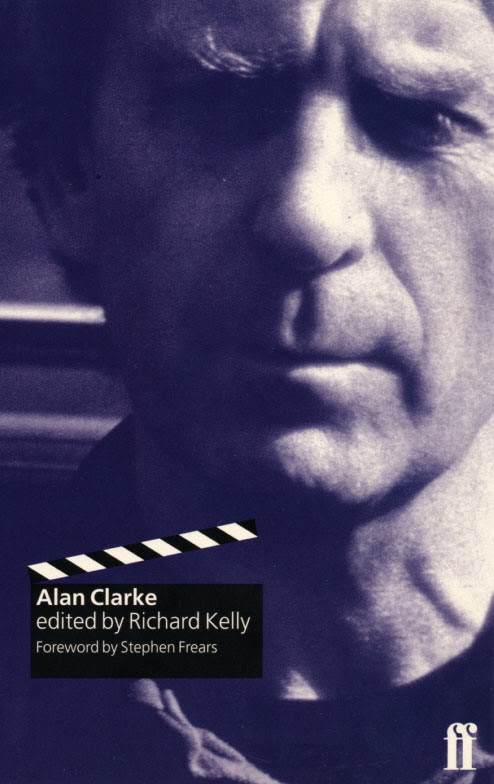
I’m always keen to have a hand in spreading the good word about Clarke. In 1998 I wrote his biography for Faber and Faber, my first published book. I say ‘wrote’ but it was really a work of oral history, George Plimpton-style, where I interviewed a wealth of his friends and family, collaborators and lovers, and stitched those transcripts into one multi-vocal life story. And I daresay Clarke’s life tells you as much about Britain, class and society in those years as his films do. My favourite review of the book, you’ll not be surprised, is this one by David Thomson, he of the Biographical Dictionary of Cinema, who was a big early champion of Clarke among the film-critical fraternity.

Now, Clarkey fans are living in exciting times, because at the end of March the BFI will start rolling out a huge tribute, ‘The Complete Alan Clarke’, with events and screenings at the South Bank and a comprehensive DVD/Blu-Ray boxset. There have been other such celebrations since Clarke’s death in 1990 – I helped Lizzie Francke and the Edinburgh Film Festival with one such in 1998 – but the BFI platform gets a huge boon from having the Clarke oeuvre packaged up so marvellously in one collectable digital set. 

Sam Dunn at the BFI has been the overseer of this great undertaking, and I’ve been happy to chip in a few embellishments to the boxset: new essays on Road and The Firm for the booklets, and an audio commentary with national-treasure actress Janine Duvitski for Diane, one of Janine's earliest screen roles, possibly her best. My book is going on sale again, and I think I’ll be giving a public talk or two once the season goes out and about countrywide.

Looking again at just a few of Clarke’s films I was pleased but unsurprised that age doesn’t wither them, because they were made with such care and conviction, such focus and force. Clarke was only interested in strong-meat subject matter, and he cut to the bone and cast aside the fat. I would love to see what new audiences will think and feel as they come for the first time to Penda’s Fen or Made in Britain, Scum or Elephant, Contact or Christine, et cetera.

Working on the book was a very happy time for me, one I owe to Walter Donohue, editor of the Faber film list who had input in that moment from the brilliant soon-to-be award-winning filmmaker Kevin Macdonald. It was late November 1997 when Kevin gave me the green light to start writing Alan Clarke – on the proviso that I deliver in March 1998 so that finished books could be ready for Edinburgh that summer. I made it, just, having met about 70 remarkable people over 16 weeks, some of them now gone, alas – such as producer Mark Shivas, cameraman John Ward, and the great Brecht scholar John Willett, who helped out Clarke and David Bowie with their remarkable Baal.

One of my treasured souvenirs from publication was a handwritten letter sent me by Christopher Eccleston, who wrote to say that Alan Clarke was the whole reason he became an actor, and that he felt my book ought to be set reading in all British film and drama schools. Well, what a lovely thought, and I wouldn’t fight it, you understand… The book, though, is only a useful companion to a body of work that ought to be required viewing for anyone who respects film. One good friend of Clarke's among my interviewees, typically mischievous, told me he thought I ought to become ‘Professor of Alan Clarke Studies at the University of Scum.’ Well, if that were the badge I’d wear it proudly.

Postscript: One of the trickier parts of biography is conveying the sense of humour of one's subject, especially if that person was/is routinely said by those who know them to be 'very funny' in person. Everyone I met thought Alan Clarke was really, really funny, and I could see why. The challenge, then, is how to adduce the right examples of witty remarks, behaviour etc so as to encourage the reader to imagine all the fun they'd have in such company. (I had the same challenge down the line with Sean Penn, who's also really funny.) 

The trouble in the case of Clarkey was that the examples my interviewees tended to offer me were either a) things that didn't work on the page, such as puns and other bits of verbal dexterity, or a certain way of looking at someone, or b) things that were, at least in the opinion of my manuscript's early readers, un-printably rude/filthy, even if in good sport. So most of those gags hit the cutting room floor... but they were certainly funny at the oral stage, in the telling and the hearing, and I do sometimes share them with other Clarkey fans in the right circumstances, i.e. when propped up agreeably at 'Mahogany Ridge'.